
The questions raised in the excerpt are all valid and important arguments to consider. We can walk through each situation and consider the possibilities of other people not being chosen or being chosen. However, that would take too long to give each situation proper attention. In this article, I want to raise the issue of elections when they concern those we know and love. If you follow along my chain of thought, you may discover that there is some validity to my arguments. It is not my intent to offend anyone’s point of view. These are my understandings and conclusions, drawn from my own studies, which have been informed and guided by the Word of God. My hope is that the reader would have an open mind to consider these things, in light of God’s Word and the Truth revealed to us in Jesus Christ. Please take everything with a grain of salt and come to your own conclusion about this doctrine. My intention is to propose another idea for consideration. I will apologize in advance if some of the points come across a little harshly or unfriendly. But this was because of the unwarranted attacks on Calvinism, Predestination, and Election from others I won’t mention online. The guilty shall remain unnamed.
When the Doctrine of Election involves those we love, we immediately become defensive and turn to offense. It upsets us because it hits home. It becomes personal. Many of us are willing to accept our own loss and fatal destinies, but when it comes to our loved ones, the gloves come off. We suddenly become the protectors of those we care about when in daily life, we don’t show or express that care to them. Whatever the case, it does not seem fair that God would choose a mother to be saved for all eternity in Christ, and yet not choose her child and instead condemn her for all eternity. Anyone with a brain would say that is cruel and unreasonable. I am not suggesting that we should blindly accept whatever is told us about the doctrine of election without fully examining all the possibilities.

I propose that we examine the Doctrine of Election in light of the entire Scripture, encompassing both General Revelation and Special Revelation from God. General Revelation is the revelation God gave of himself to all creation. We can see the magnificent power and terror of raging weather storms and fires. We crumble in fear over earthquakes and floods. In those moments, we come face-to-face with our vulnerabilities and realize we are not as in control as we thought we were. That is the general revelation of God. Knowing and witnessing the awesome power and authority of God. Throughout the Old Testament, God used nature to display His power and authority. Along with power, General Revelation is seen in the complexities of creation. No matter how large or small, we can use them to examine through a microscope or telescope, and the discoveries are endless. The more we poke into this world, the more we realize how much we don’t know. The formation and development of the human body is so complex that what we know is just a, pardon my cliche, tip of the iceberg. We do not even come close to understanding the depths of the ocean floor, the light-years of space between this universe. Regardless of the direction we attempt to study, we will never attain complete knowledge. That again is General Revelation of God. Only God can and wills what is to be in this world. Looking at nature and looking at ourselves, our human response should be like how you feel when standing on the edge of the Grand Canyon in Arizona. The general revelation of God is the knowing and realizing that there is an Almighty power and supreme Ruler of all the Universe. We can see and sense His presence in creation. It is general because it does not tell us who this God is specifically. In general, in revelation, you cannot know God’s name.
Special Revelation is the revelation of God in distinct and unique ways. For example, God’s appearance to Moses in the form of a burning bush was a special revelation of God. Throughout the Old Testament era, God has revealed Himself in special ways, but the final and complete revelation of God was in His Son, Jesus Christ. In Christ, we have the complete picture of who God is. Hearing, believing, and trusting in Jesus is confessing that you have received Special Revelation. In other words, you have seen God.
We must take into account the whole picture; otherwise, it is like taking a piece of the puzzle out of the whole set and claiming to have a doctrine and understanding of predestination and election. Never separate Scripture into parts that seem manageable to you. If you do, then you are treating the Word of God as a buffet meal. You choose and pick what you like and discard what you don’t. God is not a buffet. If you take Jesus Christ for who He is, then you must take ALL of Him; otherwise, you have not accepted the whole Jesus Christ revealed in Scripture. To do that would be like picking and choosing what I like and dislike about my spouse. Did I get married to my wife, hoping that the things I may dislike will change or eventually change? Is it right for me to pick and choose what I like and argue about what I dislike? Am I treating my spouse like a buffet?
The right and proper thing to do is accept people for who they are overall, not just what we like or can handle, but all of them. In the same way, we must accept God described in Scripture and revealed in Christ, all of who He is.

So, how should we deal with others who are not chosen? What possible answer or solution does the Bible reveal about this situation? In the Gospel of John, there is an excerpt that is often overlooked or skipped when it comes to preaching or teaching, and that is found in verses 18-23 of chapter 21. In John 21, we read of the accounts of Christ after his resurrection. He meets with his disciples and reinstates Peter’s role and place. This incident is often preached where Jesus asks Peter if he loved Him. Peter responds that he does all three times. Many commentators and pastors preach about this account, yet John continued to write, expanding the account. How dramatic would it have been to end the story right there, but John continued to tell the story of what happened. Jesus speaking to Peter instructs him of how he is to return, what he is to do, and how he will glorify God in his death. Then Jesus concludes His teaching by commanding Peter to “Follow me” (John 21:19).
Next, we have verses 20-23, where the story appears to take a turn. As the story progresses, Peter seems to be literally following Christ, as we read that John got up and also followed them. What’s interesting is that John, who wrote the Book of John, does not refer to himself in the first person, yet he describes the disciple who got up and followed Jesus and Peter. We read that Peter turned and noticed John following them. This must have upset Peter to some degree, because he asked Jesus, “What about this man?” Jesus said to him, “If it is my will that he remain until I come, what is that to you? You follow me!” 23 So the saying spread abroad among the brothers that this disciple was not to die; yet Jesus did not say to him that he was not to die, but, “If it is my will that he remain until I come, what is that to you?” (John 21:22-23)

In a sense, this scene resembles the ending of a drama movie, where Jesus and Peter walk out of the room together after Jesus reinstates Peter. You can imagine the sunset outside the entry doorway as you see their backs with lighthearted music playing in the background. Then, suddenly, Peter turns and notices John getting up to follow as well. Peter probably felt challenged or had his pride a little hurt because of all the attention and instructions Jesus just gave him. Being a man myself, and knowing how men are, the disciples most likely had banters and arguments of who was greater or lesser of the twelve amongst themselves. There were many occasions on which the disciples argued, as recorded in Luke 9:46-48, Mark 9:33-35, Matthew 18:1-4, and Luke 22:24-27. Men tend to put their pride forward first as a defense mechanism, and when Peter asked Jesus about John, Jesus’ response should help us see the overall picture of election and predestination. We are discussing Jesus’ sovereignty and His revelation of His Deity.
The first notable point in Jesus’ answer to Peter is that Christ has established His rule and reign over this Kingdom and the Kingdom to come. He is God, and God has sovereignty over all. Jesus is reprimanding Peter to stay in his lane. Don’t sway from what He has just told you; follow Him. Our problem is that when God tells us to do something, we always tend to question why. We seem to feel as though we deserve a reason to follow and obey God.

Brothers and sisters in Christ, if this is you and you feel as though you deserve a reason for God’s decision, this is God’s answer for you, found in John 21:19: Jesus said to him, “If it is my will that he remain until I come, what is that to you? You follow me!” Jesus seems a little harsh in the minds of passive people here, but we must realize why he was intentionally harsh with Peter’s inquiry. Peter asked Jesus a simple question. What about my neighbor? What about this man also following? What about John? Peter’s asking Jesus could have been out of jealousy or genuine curiosity.

In either case, Peter’s questioning Jesus about why John was following them was an insulting and ignorant question. Jesus just revealed who He was as the God of the Universe, yet Peter’s first response after being reinstated is to question Jesus. You may think that there is nothing wrong with questioning God. God is loving and, like our Father who sits and listens to our every complaint, is He not? God is loving, but only to those who are His family. God shows grace to all creation, but has a special place in His heart for those who are in Christ. Yes, God is loving, merciful, and gracious. There is no doubt about that. However, God is not flexible with His Laws and obedience. Holiness is required to be in the presence of God. If there is any imperfection found within a being, they are cast out of the presence of God. Sin cannot exist in God’s presence. God is holy and cannot dwell amongst sin. So questioning God is not the real issue here. God is loving and does answer our questions, just as a child asks their parents questions during their toddler years. The problem with Peter’s question is that the first act of creation, in introducing sin into the universe, was in the form of a question. In Genesis 3, we can read about the Serpent causing doubt and disbelief in the hearts of Adam and Eve by asking them one question. “Did God really say…?” God’s authority, rule, and reign were suddenly questioned for the first time ever. There was no doubt in God, yet Satan himself raised a question that initiated doubt in the heart. In the Book of John, right after Jesus reveals His deity, authority, and reign, Peter’s first words were in the form of a question. Jesus probably thought, “Are you kidding me, Peter? Has the Devil enticed your lips to try to go back to the Garden of Eden again? The war is over, and I have won! Enough with the questions.” That’s just my speculation, but Jesus’ response seems to align with human emotion. Peter was challenging Christ’s will and authority. Peter should have known better and stayed quiet, humbly grateful that Jesus restored him to the fold. Rather, Peter got jealous and raised a question that irritated Jesus, like a bruise to the heel.

Rolling it back to the doctrine of election, our duty is not to question God about this person or that person. Yes, I fully understand that there is a pain point that hurts deep within all of us. And that pain point is possibly discovering that a loved one is not elected, if that were possible. That would crush me, and anyone else who has ever loved another human being. To know that you received the greatest gift and blessing anyone could ever ask for, at the same time, realizing there is nothing you can do about your loved one’s salvation in Christ. What kind of dark and horrible corner it must be to feel that. I can only imagine. I am not saying I do not sympathize with that sentiment, and I, too, have and know many people, family, and friends who I can assume are not truly saved. I, too, can ask the same questions, which I have often wrestled with God. But to no avail, no such answer came to me other than Job 38:1-4.
Then the Lord answered Job out of the whirlwind and said:
“Who is this that darkens counsel by words without knowledge?
Dress for action like a man;
I will question you, and you make it known to me.
“Where were you when I laid the foundation of the earth?
Tell me if you understand.
Whenever God is questioned, the results are usually not good. It is not a matter of God desiring authority and demanding that all his creation bow down to him. (In reality, that is what all creation must do). God is not a tyrant who forces all to worship Him. Again, don’t take parts of God’s nature and create doctrine from it. Take God in the whole as He has revealed Himself. God is both just and merciful. God demands obedience, yet is also gracious. God gets angry, yet remains loving. So, God is not arbitrarily demanding worship from His creation, but He is preventing His creation from falling again. If you ask God questions that are beyond your understanding, you are playing on dangerous ground. The only thing you should be focusing on is following Jesus. Your life’s call and God’s will for you in this life is to follow Jesus. Don’t look around, don’t question others’ faiths, but follow Jesus. God deals with each and every one of us individually; at the same time, He is not a personal Jesus. We were saved into a family, which is the Church of Christ, and we are meant to encourage and build up one another in Christ. But when it comes to an individual’s faith, then we are to back off and trust that the Holy Spirit has it. Seriously, what more can you add to the works of the Holy Spirit in the heart of a person refusing to believe in Jesus Christ? Can you do better? Let us not be delusional; let us remember who God is and who we are.

If you are reading this and know that you are chosen, then glory be to God for your eternal security in Heaven. If you are reading this and regularly attend Church, yet still harbor doubts and disbelief in your heart, then I ask that you consider all that you have just read and be open-minded to the possibility that there is a greater authority and power over you and your life. Are you truly in control of your life, or are you maintaining it? Do you react to situations and problems, or do you take control and make it what you want? Examining the pattern of thinking and responses you exhibit daily will reveal your current level of faith. If you have a hard time accepting that God may be in control, and you are not, then you still have not accepted and understood who God is. If there is even a hint of doubt and disbelief in your heart concerning Jesus Christ and who He is, then your faith is in vain, because faith seed cannot grow on rocky soil, or pathways, but only on soil that the Farmer prepared and planted. The seed had no say in what it would grow to be, nor did it question why it was made the way it was. The seed was just planted by the Farmer, and it grew over time. The same goes for your faith. God plants the seed of faith within your heart, and the Holy Spirit of God waters it and causes it to grow. The seed did not plant itself, nor did it make a decision to be planted in this pot or that pot. The seed just obeyed, did its thing, and grew.
What is my point? We have no say in whether we can be chosen or not. It is purely God’s prerogative to make His own decision. You may say, Well, easy for you to say that, coming from the elected side. What about those who are not elected, such as myself? What can you say to that? THe premise of the question starts from the wrong perspective. If you feel this way, then answer me this, How are you so sure you are not elected? Did you have insight into the mind of God, or are you assuming you are not elected? What reason would you have for beleiving you are not elected? Who is to say you will not experience conversion in Christ and a changed life later on in your years? maybe this is the starting point of your calling? In the same way we cannot know who is elected or not, we cannot assume some people are not elected forever. We live in space and time, and the future is not known to us. These are knowledge too wonderful to grasp, and must be held inside our pockets next to our hearts, and fully trust in the God we already know.
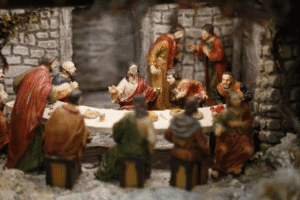
Let’s be clear in this matter so that there is no confusion, as your mind and heart will continually waver back and forth regarding election or non-election. You have been introduced to the depths of theology, and this is possibly the greatest difficulty in all theological categories. Churches have bled and fought over this one doctrine of election, so we must be clear. Reading the story again, we can see that John just got up and followed. We don’t read of Jesus telling John to follow. He just gets up and follows. We can ask why John did this. What cause or motivation did John have to follow when Jesus told Peter to follow? My only conclusion would be that John was just doing what he does, following Jesus. John received the call years ago when Jesus first called His disciples. Since that call, John never disobeyed. He just kept following, without asking any questions. If Jesus were leaving the room, John would be there. If Jesus said anything, John wanted to be there to hear it. John loved Jesus so much that he wanted to be by His side always. That is the heart of a true disciple, willing to follow Jesus no matter what, without asking why. If we could only all be like John.

But many of us still struggle with this doctrine of election. We seek hard facts, clear answers, and compelling evidence that our loved ones will live beyond this world. We want to know that Jesus chose them and loves them. We want some assurance to find peace. Yet the only answer we get is, “What is that to you? You follow me!” Jesus is correcting Peter in his loss of focus. He is telling Peter to look at Him rather than at the others around him. Don’t be like Lot’s wife, who looked back after leaving Sodom and Gomorrah (Gen 19:26). Her heart was still longing for the old life, rather than continuing on the path to the new. Her reason for looking back was that she questioned God in her mind if the new life was really that much better than the old. Her heart was still in Sodom. Jesus wants Peter to no longer waver and sway to and fro. Jesus is directing Peter in the course he was chosen to follow. Jesus is disciplining His disciples.

Romans 9 is about the sovereignty of God. It is not about who gets chosen or who is damned to destruction. It is about understanding and knowing the supreme authority and power of God in this Universe. He is the King and Ruler of all creation. The real question you should be asking yourself is not what about this person or that person, but, “Why me? Why did God choose me? Did he have to choose me? Was there any obligation on God’s part that he had to choose me? Did I merit anything in the sight of a holy God? What possible merit could deserve anything worthy of God’s attention?”
God is not one to be treated like we treat others in this world. God is above all else and must be revered and honored. Questioning God is a delicate matter and should be approached with care. Asking about others’ salvation should not be a reason to reject God’s authority and rebel. Although the emotions and feelings are valid, we must be more concerned about the state of our faith first, before thinking of others. That may sound a little selfish, but we do the same in an emergency situation on an airplane. If the oxygen masks deploy, the staff instructs us to put on our own mask first, so that we can remain alert to assist those around us. Consider who Jesus Christ is to you first, before sharing with others. If you do not have a genuine, personal relationship with Jesus on a daily basis, then it may be time to seriously consider who Jesus is.
The Bible teaches us that John’s example of obediently following Christ’s call is an example that all believers should follow. Not what Peter did in questioning God’s decisions. Who is God in your life? Is Jesus the Lord of your life, or is He just an addition to your busy schedule?

You may still feel uneasy even with the explanation of correcting our thoughts and reasons for asking our questions. I still get your dilemma. Let’s look at it from a practical point of view to conclude this article and set this issue. We can only know with certainty whether we, as individuals, are saved or not through grace in Christ. It is a personal matter, not anyone else’s. However, when it comes to those we love and cherish, how should we approach the situation? Are we to go around and judge others by telling them they are or are not saved? Heaven forbid that happens. We are never to judge the salvific state of another person. We cannot see their heart, nor do we know everything about them. We can only know what they reveal about themselves, but even in a tightly closed family, no other member knows another member to the degree that they know their heart. If that is the case, and we cannot know another person’s heart, then what are we to do about evangelism and sharing the Gospel? The Bible never says where to declare someone saved or not saved. The Bible only instructs us to be a witness for Him and to follow Him. Regardless of someone’s state of faith, you are a witness for Jesus. Whether they believe or not, you are a witness to the Truth. Regardless of whether they are chosen or not, you are a witness. Let me take it a little further and ask you, if by chance God were to tell you who was saved and who was not, what would your response be? Let’s take your child, for instance. If God were to tell you and guarantee your child is saved, what would you do as a parent? Being sinful people that we are, most likely we would sit back, do nothing, and every time the child strays away or leaves the Church, you would pull out your guarantee card you received from God and throw it in the face of God, claiming He promised they would be saved. Obviously, this is the wrong approach, and because a mixture of faith and promise is involved, it is difficult to analyze clearly whether that is the right approach or not. In fact, it is not the right approach, as it ultimately constitutes a form of abuse. You are basically neglecting the duties of a disciple, while at the same time trusting that God will do it. This mixture of truth and falsehood is what confuses most.

On the other hand, if we knew that someone was not chosen, would that prevent us from witnessing? For what reason would we witness to that person? They are not chosen and have no hope in Christ. Why waste breath on someone who is a reprobate (non-elected)? And again, we come across a dilemma that confuses us even more. What do we do about reprobates? Those who were not chosen for eternal life in Heaven? Do we witness to them? Absolutely! Because we do not know who is saved and who is not. That knowledge only belongs to God, and it is too great for us to comprehend God’s reasoning. We can only know what God reveals, and God clearly instructs His disciples to be witnesses of Him throughout all generations and peoples in the world. Ultimately, you and I do not know who is saved and who is not. We can infer that if our child continues attending church with their family, then they are likely better off than if they were not. Meaning, anyone who is close to the fold of God will most likely be part of that fold. Does that mean we should force our children to attend church with us every Lord’s day? Forcing someone to do anything only results in rebellious responses. But having them near the Church family and surroundings can help in their understanding of the Gospel. It is always better to be near the source of light to see more and find clarity. If you are far from the light, the light will look small, and darkness will engulf your surroundings.

So, are we to focus solely on our own salvation and sanctification and ignore others’ state of faith? No! We are to learn and grow in Christ as we keep watch of our own walk, but we cannot carry anyone else, nor are we able to give our faith to others. What you can do for others is learn to trust in the Lord. You help others by trusting in God. God is the only one who saves, not you. God can turn their hearts around in a second if he wills. For some reason, he has not will it for you yet, but that is not to say He will not. It is always in God’s timing that things happen and things move. Change occurs when God intervenes, and if you are struggling with these thoughts, then wait on the Lord to intervene. It may take time, depending on what God wants you to learn, but in the end, you will praise Him for His choices and not grumble. You will say God’s choice was perfect and true, and no other way, method, timing, or obstacle could have changed it otherwise. God is in control. Trust is not shallow or easy. Trust means fully trusting in God’s decisions and choices. Again, I will ask you, who is God, and who are you? Can a pot ask the maker, Why have you made me this way? (Romans 9:20-21). Can a pot even speak? Is the pot asking a question to the Potter?