
To understand Christmas rightly, we must learn to separate what is biblically grounded, what is historically developed, and what is culturally inherited—and then ask how a Christian, shaped by Scripture, should respond.
 From a Reformed theological perspective, this distinction matters. Scripture alone governs faith and worship, but culture shapes how faith is expressed. Christmas sits at the intersection of both.
Christmas celebrates the incarnation: the eternal Son of God taking on human flesh. “The Word became flesh and dwelt among us” (John 1:14). That truth is central, non-negotiable, and glorious. Yet the way Christians have celebrated it has varied greatly across time, geography, and tradition.
 The earliest Christians did not celebrate Christmas as we know it today. In the first centuries of the Church, the focus was overwhelmingly on Christ’s death and resurrection. Easter stood at the center of the Christian year. The exact date of Jesus’ birth was unknown, and Scripture does not command its observance.
 By the fourth century, December 25 became widely recognized as the date for celebrating Christ’s birth. Some argue this was chosen to replace pagan festivals such as Saturnalia or Sol Invictus. Others note that early Christians often dated Jesus’ conception to March 25, which would place His birth nine months later. Historically, both explanations may have influenced the final date. What matters theologically is not the calendar date but the truth being confessed: God entered history as a child, humbling Himself for our salvation.
 Reformed theology has historically held a cautious view toward church festivals. The Reformers affirmed the incarnation wholeheartedly but warned against elevating man-made traditions to the level of divine command. John Calvin emphasized that human ceremonies must never bind the conscience where Scripture does not. Yet even within Reformed churches, Christmas has often been observed as a teaching opportunity rather than a mandated holy day.
This brings us to the practices most commonly associated with Christmas.
 The Christmas tree, for example, has German roots and became popular among Protestant Christians in the early modern period. Evergreen trees symbolized life in the midst of winter, and Christians often interpreted them as reminders of eternal life in Christ. While some point to pagan symbolism, there is no direct historical evidence that the Christmas tree originated as a pagan religious object later baptized by the Church. Like many cultural symbols, its meaning depends on how it is understood and used. A tree adorned to celebrate Christ’s birth is not an act of worship in itself but a cultural expression of joy.
 Lights play a similar role. In the darkest season of the year, light has always carried symbolic power. For Christians, light naturally points to Christ, the Light of the world. Scripture itself uses this imagery repeatedly. Yet stringing lights on a house does not automatically glorify God. It becomes meaningful when it reflects a heart responding to the gospel rather than mere seasonal decoration.
 Gift-giving is one of the most cherished Christmas traditions, often tied to the Magi who brought gifts to the infant Jesus. Historically, gift-giving at Christmas expanded over time, influenced by figures such as Saint Nicholas and later cultural developments. Biblically, generosity is a Christian virtue year-round, not seasonally mandated. When gift-giving becomes an expression of love, gratitude, and generosity, it reflects Christian values. When it becomes consumerism, debt, or pressure, it distracts from them.
 Music has always been central to Christian worship, and Christmas music holds a unique place in church history. Many of the great hymns of the faith focus on the incarnation, carefully expressing profound theology in poetic form. “Hark! The Herald Angels Sing” and “O Come, O Come, Emmanuel” are not sentimental songs; they are doctrinal statements set to music. At the same time, modern Christmas music often blends sacred and secular themes. Discernment is needed to distinguish what teaches truth from what simply evokes nostalgia.
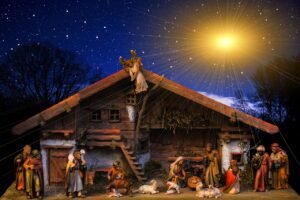 Nativity scenes, or crèches, developed as visual teaching tools, particularly in times when literacy was limited. They depict biblical truths in physical form. From a Reformed perspective, visual representations are acceptable when they instruct rather than invite worship of the image itself. The danger lies not in depiction, but in devotion misdirected toward the object rather than the Christ it represents.
 Santa Claus is perhaps the most debated figure of the season. Based loosely on historical accounts of Nicholas of Myra, a generous bishop, Santa has evolved into a largely secular symbol. Reformed theology would caution against allowing fictional figures to overshadow the person and work of Christ. Yet families differ in how they approach this tradition. The guiding principle is honesty, clarity, and intentional Christ-centered teaching.
 Christmas meals and gatherings highlight another biblical theme: fellowship. Scripture repeatedly shows God’s people gathered around tables. Hospitality, shared meals, and celebration are not distractions from faith but expressions of it—when they are rooted in gratitude to God rather than excess or self-indulgence.
As Christmas transitions into the New Year, another set of traditions emerges. New Year’s celebrations are not inherently Christian, but they raise deeply theological questions: time, change, repentance, and hope. Scripture often marks seasons and years as opportunities for reflection. While the Bible does not command New Year’s resolutions, it does call believers to continual repentance, growth, and renewal of the mind.
 From a Reformed perspective, the New Year is a fitting moment to remember God’s sovereignty over time. Every year unfolds according to His providence. Every plan we make is held loosely under His will. New beginnings are not ultimately found in calendars, but in Christ, who makes all things new.
The danger of both Christmas and New Year celebrations lies not in participation, but in forgetfulness—forgetting why Christ came, forgetting who God is, and forgetting that our hope rests not in tradition, emotion, or fresh starts, but in the finished work of Jesus.
 The beauty of these seasons lies in opportunity. They offer moments to teach the incarnation, proclaim the gospel, practice generosity, cultivate gratitude, and bear witness to the hope of redemption in a watching world.
Christmas traditions are not commands from Scripture, nor are they automatically unchristian. They are tools. And like all tools, they must be handled with wisdom.
When Christ stands at the center, traditions can serve faith. When He is pushed aside, even sacred seasons lose their meaning.
 The question every believer must ask is not, “Are we celebrating correctly?” but rather, “Are we celebrating Christ faithfully?”
That question, asked honestly, reshapes Christmas, the New Year, and every ordinary day that follows.