
Deep End Theology – A Faith For U Today Podcast
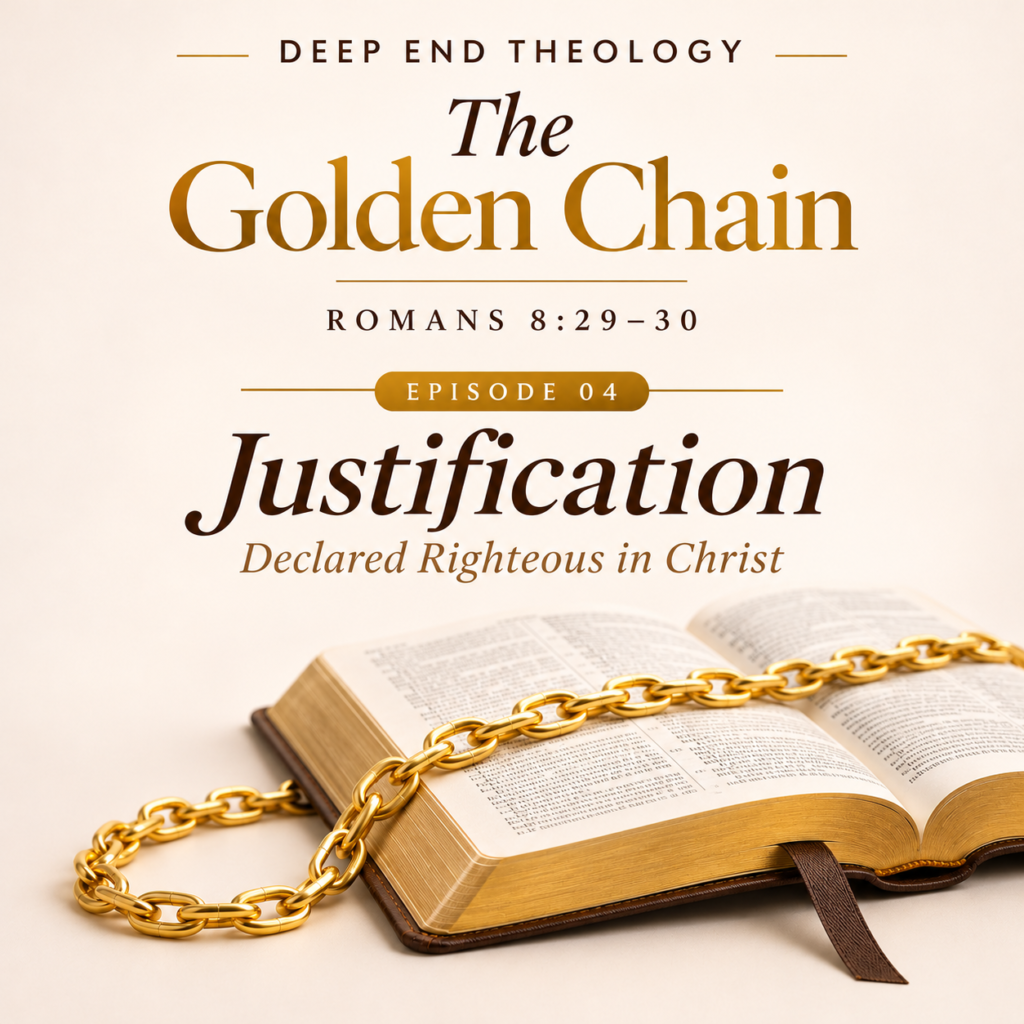
Episode 04 — Justification: How God Declares Sinners Righteous in Christ
The Golden Chain has now moved from God’s eternal purpose into the actual experience of salvation. Those whom God foreknew He predestined, those whom He predestined He called, and then Paul writes, “those whom he called he also justified.”
With that single word, we arrive at one of the central questions of the Christian faith: How can a holy God accept guilty people?
The question becomes especially personal once we stop treating sin as an abstract doctrine. Christians still fail. We discover selfish motives in apparently good actions, return to sins we thought we had defeated, and sometimes find ourselves wondering how God could possibly continue to receive us. The question is not only whether God forgives, but how He can forgive without compromising His own righteousness.
Justification is the biblical answer.
The source for this episode defines justification as God’s legal declaration that the ungodly are righteous in His sight because of Christ, received through faith alone. It is not God pretending sinners are morally perfect, nor is it His declaration that they have finally improved enough to deserve acceptance. It is a verdict grounded in the righteousness and saving work of Jesus Christ.
Understanding that distinction changes the Christian life. If our standing with God depends on our spiritual performance, assurance will always rise and fall with that performance. If our standing rests on Christ, obedience can finally become gratitude rather than an attempt to earn a verdict.
The Courtroom Behind Paul’s Language
Paul develops the doctrine most clearly in Romans 3 and 4, and the setting is unmistakably judicial. Humanity stands accountable before God. Sin is not merely a wound needing treatment; it also creates guilt before a righteous Judge.
Romans 3 first closes every escape route. No one will be justified by works of the law because the law exposes sin rather than providing guilty people with a record capable of vindicating them before God.
Then Paul announces something unexpected. A righteousness from God has been revealed apart from the law, although the Law and the Prophets bear witness to it. Sinners are justified by God’s grace as a gift through the redemption that is in Christ Jesus.
The courtroom remains, but the verdict changes.
The sinner does not produce the righteousness the court requires. God provides it in Christ.
This is why the Protestant doctrine of justification has historically been called forensic. The word simply means that justification concerns a legal verdict. God declares the believer righteous rather than waiting until that believer becomes morally flawless before accepting him.
That distinction should not be confused with the claim that God has no interest in changing His people. The New Testament clearly teaches inward renewal, holiness, and transformation. The issue is whether that transformation is the basis of God’s justifying verdict.
Reformed theology says it is not.
God first receives the believer because of Christ, and the believer’s transformation follows from that grace.
God Justifies the Ungodly
Romans 4 contains one of the most surprising descriptions of God in Scripture: He is the God who justifies the ungodly.
That phrase is easy to read too quickly.
Paul does not say God justifies people once they have stopped being ungodly enough to qualify. He describes justification as something God does for sinners who have no righteousness of their own to present as payment.
Paul contrasts wages and gift. A worker receives wages because something is owed. Salvation does not operate that way. The person who trusts God does not present faith as another work that earns righteousness. Faith receives what God gives.
Abraham becomes Paul’s great example. Genesis says Abraham believed God and it was counted to him as righteousness. Paul repeatedly uses the language of counting or crediting, which is why imputation became so important to Protestant theology. The episode source describes this as righteousness being credited to the believer rather than produced by the believer as the basis of acceptance.
Faith, therefore, is not the ground of justification.
Christ is the ground.
Faith is the instrument by which Christ and His benefits are received.
That difference protects the Gospel from turning faith itself into another spiritual achievement.
The Problem of Our Record and the Gift of Christ’s
Romans 5 broadens the picture by comparing Adam and Christ.
Adam stands as a representative head whose disobedience brings condemnation. Christ stands as the righteous representative whose obedience brings justification and life.
This helps explain why imputed righteousness is not a legal fiction.
The Christian claim is not that God looks at a sinful person, ignores reality, and simply announces that sin does not matter. The verdict rests upon a real representative and a real righteousness.
Jesus obeyed.
Jesus suffered.
Jesus died.
Jesus rose.
The believer is united to Him.
The righteousness credited to the believer is not imaginary righteousness. It belongs to Christ.
That is why the source contrasts imputed righteousness with infused righteousness. Reformed theology certainly teaches that the Holy Spirit changes believers inwardly, but it locates that transformation under sanctification rather than making it the basis upon which God justifies.
That separation is not meant to divide Christ’s work into unrelated pieces. It is intended to preserve the order of grace.
God does not transform us so that He can eventually accept us.
He accepts us in Christ and then transforms those He has accepted.
Why the Difference Matters So Much
The distinction may initially sound like something only theologians need to worry about, but it quickly becomes pastoral.
Imagine a Christian who thinks God’s acceptance depends partly upon how much progress he has made.
A good spiritual week produces confidence. Scripture has been read consistently, prayer has gone well, temptation has been resisted, and relationships feel healthy. God seems near.
Then comes a bad week.
The same sin appears again. Prayer becomes irregular. Anger wins. Something shameful happens. Suddenly the believer begins behaving as though justification has been suspended until enough good behavior has accumulated to restore the account.
That is not how Paul describes justification.
The verdict rests on Christ.
This does not mean sin has become unimportant. It means repentance no longer functions as an attempt to earn re-entry into God’s favor. The Christian confesses sin precisely because he belongs to Christ and can come into the light without constructing a defense.
There is an enormous difference between repentance and bargaining.
Repentance says, “I have sinned, and I need the mercy Christ has secured.”
Bargaining says, “If I improve enough, perhaps God will take me back.”
Justification makes the second approach unnecessary.
Legalism and Antinomianism Miss the Gospel in Opposite Directions
The source identifies two opposite errors that justification helps us avoid.
The first is legalism, which treats spiritual improvement as the basis of acceptance with God. Christ may still appear in the system, but He gradually becomes an assistant helping us construct the righteousness by which we hope to be accepted.
The second is antinomianism, which assumes that if acceptance is by grace, obedience no longer matters.
The Gospel refuses both.
Justification is entirely gracious, but the faith that receives Christ is not sterile. God does not justify sinners because of their works, yet the justified person is also brought into a new life in Christ.
Ephesians 2 makes the order clear. Salvation is by grace through faith, not the result of works so that no one may boast. Yet the same passage says believers are created in Christ Jesus for good works.
Works do not become the root of acceptance.
They become fruit.
The order matters because reversing it changes Christianity into something else.
Paul and James Are Not Enemies
This brings us to one of the most familiar objections to justification by faith alone.
Paul says that a person is justified by faith apart from works of the law.
James says that a person is “justified by works and not by faith alone.”
At first glance, the statements appear contradictory.
The episode source resolves the tension by paying attention to the different errors Paul and James are confronting. Paul opposes self-righteousness—the idea that works provide the basis of our right standing before God. James opposes dead profession—the claim that someone possesses saving faith even though that supposed faith produces no evidence of spiritual life.
Paul asks, in effect, “How is a sinner declared righteous before God?”
James asks, “What does genuine faith look like when it exists?”
Their answers belong together.
Works cannot purchase justification.
But genuine faith does not remain alone and fruitless.
James therefore vindicates living faith by its works rather than replacing Christ’s righteousness with human merit.
That is why the old Reformation summary remains useful: we are justified by faith alone, but the faith that justifies is never alone.
Different Christian Traditions Understand Justification Differently
The doctrine became one of the great dividing questions of the Reformation because Christians did not disagree merely about whether grace was important. They disagreed over the nature of the righteousness by which sinners stand before God.
The source presents the Roman Catholic view as understanding justification to include both forgiveness and inward renewal through infused grace. In that framework, the transformation produced in the believer belongs within justification itself rather than being sharply distinguished from it.
The Eastern Orthodox tradition often describes salvation less through courtroom categories and more through the language of healing, participation, communion with God, and theosis. That emphasis can highlight biblical dimensions of salvation that should not be ignored, although the Reformed tradition insists that the judicial question of guilt before God must also be answered.
The classic Lutheran and Reformed position understands justification as a forensic verdict in which sins are pardoned and Christ’s righteousness is credited to the believer. Sanctification necessarily accompanies salvation but does not become part of the ground of justification.
The episode source also considers the New Perspective on Paul, which has drawn attention to the covenantal and Jew-Gentile dimensions of Paul’s teaching. That scholarship has helpfully reminded readers that Paul’s letters address the formation of one people of God in Christ. Reformed critics, however, argue that Paul’s concern reaches deeper than covenant boundary markers because Romans 1–3 presents universal human guilt before divine judgment.
These differences are substantial, and they should be represented without caricature. The Reformed concern remains that if our inward moral renewal becomes part of the basis of God’s favorable verdict, assurance ultimately becomes dependent upon an unfinished work within us rather than the finished work of Christ for us.
What About Judgment According to Works?
Another difficult question comes from passages that describe a final judgment according to deeds.
Romans 2 speaks of judgment according to works. Jesus describes a final separation in Matthew 25 in which the lives of people reveal something significant about their relationship to Him.
Does this mean works eventually become the basis of justification after all?
The source’s Reformed answer is that works function as evidence and public vindication of genuine faith rather than as the meritorious ground of the believer’s acceptance with God.
This is possible because justification and sanctification are inseparable even though they must not be confused.
The person whom God justifies is not left spiritually dead forever. Grace begins to produce fruit.
That fruit remains imperfect. It can never replace Christ’s righteousness. But its presence matters because saving union with Christ is living union.
Final judgment therefore does not reveal that Christians secretly saved themselves through sufficient moral achievement. It publicly reveals the reality of the grace that has already been at work in them.
How Justification Changes Prayer
One of the simplest ways to tell whether justification has moved from doctrine into the heart is to listen to the way we approach God after failure.
A person who lives functionally under a system of merit tends to withdraw after sin. He may avoid prayer for a few days, try to improve his behavior, and eventually return once he feels respectable again.
Justification teaches another way.
The Christian comes because Christ is his righteousness.
Prayer is no longer a negotiation in which good behavior purchases access to God. The believer approaches as a child whose access rests upon Christ.
That does not make confession casual.
It makes confession honest.
When your record is no longer your defense, you are finally free to stop defending it.
How Justification Changes Suffering
The doctrine also changes the way Christians interpret suffering.
Without a settled verdict, suffering can easily be read as evidence that God has returned to the courtroom and reopened the case.
Perhaps this illness means God is punishing me.
Perhaps this loss proves He has rejected me.
Perhaps my circumstances mean the verdict has changed.
Romans 8 begins with the opposite declaration: there is now no condemnation for those who are in Christ Jesus.
Christians may experience divine discipline. Hebrews speaks clearly about a Father who disciplines His children.
But fatherly discipline and judicial condemnation are not the same thing.
For the justified believer, suffering is never God demanding another payment for sins Christ failed to cover.
The verdict has already been rendered.
How Justification Changes Obedience
Justification also gives Christian obedience an entirely different motive.
If obedience is an attempt to earn acceptance, even apparently good behavior becomes anxious and self-centered. We serve partly to secure ourselves. We compare ourselves with others because their failures make our own record appear stronger. We hide weaknesses because weakness threatens the image on which our confidence depends.
Grace begins dismantling that system.
The justified Christian does not need a spiritual résumé to enter God’s presence.
That makes it possible to serve without constantly asking what the service proves about us.
It allows Christians to love their neighbors without using those neighbors as measuring sticks for their own righteousness.
And it gives obedience a healthier motive.
Not payment.
Thanksgiving.
The Verdict That Does Not Need to Be Re-Earned
Justification occupies a crucial place in the Golden Chain because Paul is showing us the certainty of God’s saving work.
Those whom God calls, He justifies.
The verdict is not provisional.
God does not justify someone on Monday and return the person to condemnation on Friday because sanctification has been disappointing.
The believer may need correction, confession, discipline, restitution, and renewed obedience. None of those things should be minimized.
But they do not constitute a new payment plan for justification.
Christ remains the believer’s righteousness.
That is why justification can produce both deep humility and genuine assurance. Humility comes because we contributed nothing that could boast before God. Assurance comes because the righteousness on which the verdict rests is not the unstable righteousness of the believer.
It is Christ’s.
The Christian therefore does not stand before God saying, “Look at what I have become.”
He stands saying, “My hope is Jesus Christ.”
And only from that secure place can the work of transformation be understood properly.
Coming Next — Episode 05: Sanctification
The Golden Chain moves directly from justification to glorification in Romans 8:30, but the Christian life lived between those realities involves a great work that Scripture describes throughout the New Testament: sanctification.
Justification answers the question, “How can a guilty sinner be accepted by God?”
Sanctification asks a different question: “How does someone already accepted in Christ actually become more like Christ?”
The next episode will examine why justification and sanctification must never be confused, but also why they can never be separated. We will look at the Holy Spirit’s work, the believer’s real effort in fighting sin, progressive growth, the ordinary means of grace, and why slow or uneven sanctification does not require Christians to rebuild their justification every time they stumble.
God does not only declare His people righteous in Christ.
He also begins making them holy.
All glory belongs to God.