

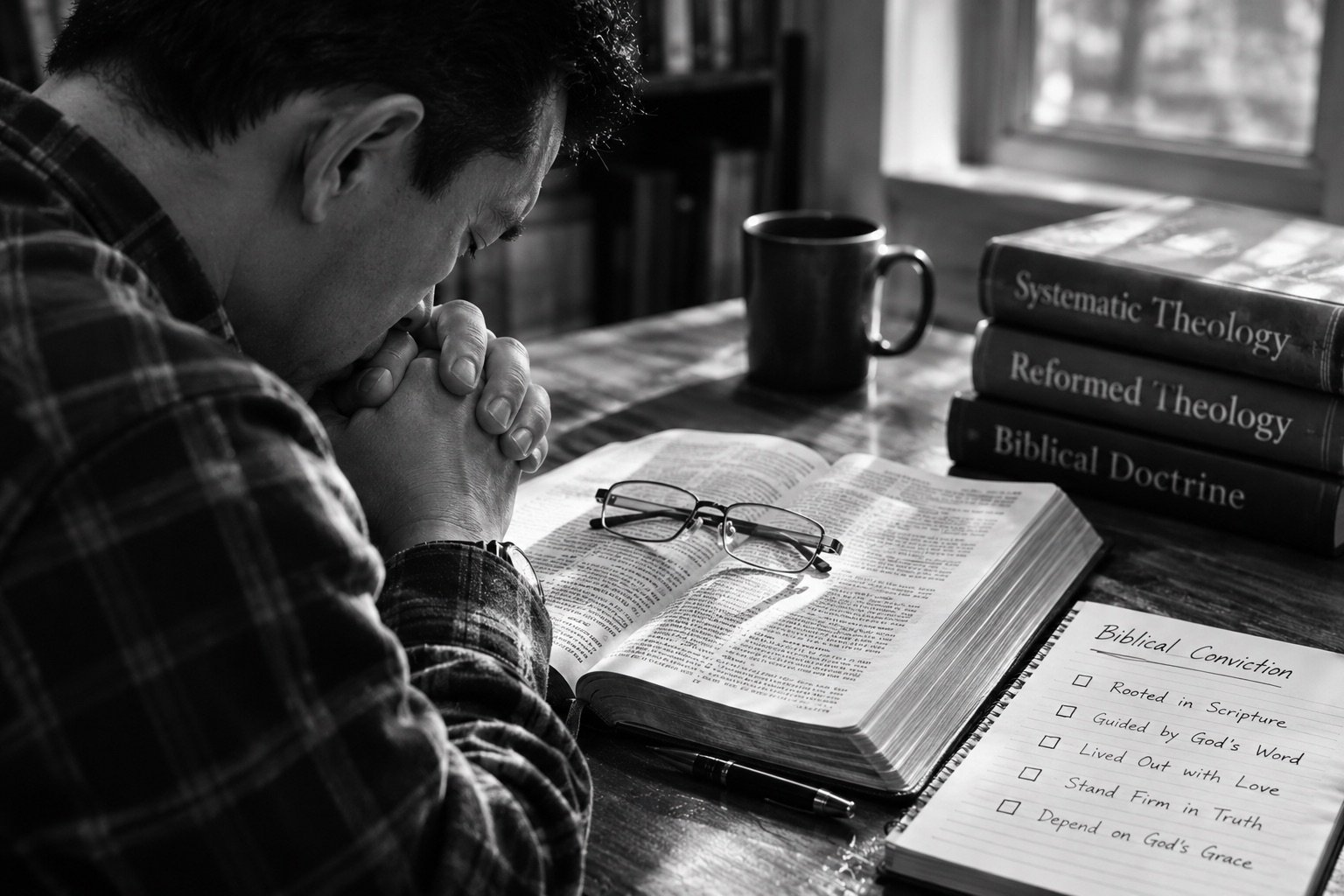
Have you ever found yourself in a situation where you knew what you believed was right, but standing by that belief might cost you something? Perhaps everyone around you agreed on a particular decision, and you were the only person who had concerns. Maybe a friend asked you to support something you believed was contrary to Scripture. Or perhaps you were placed in a position where remaining silent would have been much easier than explaining why you could not participate.
What would you do?
I think most Christians would like to believe that they would stand firmly upon God’s Word regardless of the consequences. We read about the courage of biblical figures, admire their faithfulness, and imagine that we would respond in much the same way.
But there is a difference between admiring someone else’s convictions and living according to our own when those convictions are tested.
It is easy to say we believe in honesty when telling the truth costs us nothing. It is easy to defend biblical morality when everyone around us shares the same values. And it is easy to speak about courage when we are surrounded by people who agree with everything we say.
But what happens when obedience becomes inconvenient? What happens when our convictions create tension within our relationships, threaten an opportunity, or make us appear unreasonable to people whose opinions we value?
That is when we discover whether our beliefs are simply ideas we enjoy discussing or truths we are genuinely committed to following.
Now, before we go any further, I want to make an important distinction. Having strong convictions does not automatically mean those convictions are biblical. Some people are extraordinarily confident about things they have never seriously examined. Others confuse personal preferences, political opinions, family traditions, and cultural assumptions with the commandments of God.
A person can be absolutely convinced that something is true and still be completely wrong.
And that is why the Christian life requires more than simply having strong opinions. We need convictions that are established by Scripture, informed by wisdom, and expressed through humility and obedience to Jesus Christ.
Because ultimately, the question is not whether we are willing to defend what we believe.
The question is whether what we believe is actually grounded in the Word of God.
The Difference Between Conviction and Personal Preference
Let me give you an example.
Imagine two Christian families who are trying to make decisions about their children’s education. One family believes that homeschooling is the wisest option for their particular circumstances. The other believes their children would benefit from attending a local school.
Both families sincerely desire to honor God. Both recognize their responsibility to raise their children in the knowledge and instruction of the Lord. And both have carefully considered their children’s needs, the opportunities available to them, and their responsibilities as parents.
But they reach different conclusions.
Does that automatically mean one family is being faithful while the other is disobeying God?
Not necessarily.
Scripture gives parents clear responsibilities concerning the instruction, care, and discipline of their children. But it does not command every Christian family to use one particular modern educational arrangement.
The difficulty arises when we take a decision that requires wisdom and begin treating our own conclusion as though it were a universal command from God.
Now, I understand why this happens. When we have carefully considered an issue and reached a conclusion, we naturally develop confidence in that decision. And sometimes we become so convinced that our choice is the best one that we begin questioning the faithfulness of anyone who chooses differently.
But we need to be careful.
There is a significant difference between saying, “I believe this is the wisest decision for my family,” and saying, “Every Christian who disagrees with me is disobeying God.”
The first statement recognizes a responsibility to exercise biblical wisdom. The second assumes that our personal application possesses the same authority as Scripture itself.
And those are two very different things.
Paul addresses questions of conscience and differing practices among believers in Romans 14. Some Christians were comfortable eating certain foods, while others abstained. There were also differences concerning the observance of particular days.
Rather than commanding believers to condemn one another over these disputed matters, Paul instructed them to act before the Lord with a sincere conscience and to avoid treating one another with contempt.
In Romans 14:5, he writes that each person should be fully convinced in his own mind.
But notice something important. Paul is not teaching that every personal opinion becomes true simply because someone sincerely believes it. Nor is he suggesting that Christians may disregard clear biblical commands whenever their conscience tells them otherwise.
He is addressing matters in which believers had differing practices that were not, in themselves, violations of God’s moral law.
That distinction is essential.
God has clearly condemned lying, theft, adultery, idolatry, and numerous other sins. We do not have the freedom to redefine these things according to our personal preferences.
But when Scripture does not prescribe one particular course of action, we must learn to exercise wisdom and Christian liberty without turning our conclusions into requirements for everyone else.
This is where humility becomes so important.
Sometimes living with biblical conviction means standing firmly against something Scripture clearly condemns. Other times it means recognizing that God has not given us authority to bind another person’s conscience to our personal judgment.
Both require faithfulness.
And I would argue that knowing the difference is one of the marks of spiritual maturity.
When Truth Becomes Unpopular
There is an account in the Old Testament that I think offers an important lesson about what it means to speak truth when everyone around us would prefer to hear something else.
In 1 Kings 22, King Ahab of Israel is considering going to war against Ramoth-gilead. He consults a large group of prophets who encourage him to proceed, assuring him that the campaign will succeed.
Imagine the atmosphere.
The king wants to hear that his plans will work. The prophets provide the encouragement he desires. And nearly everyone appears to be in agreement.
But King Jehoshaphat of Judah asks whether there is another prophet of the Lord who can be consulted.
Ahab reluctantly mentions Micaiah, a prophet whom he dislikes because Micaiah does not speak favorably about him.
Already, we can see the problem.
Ahab is not primarily interested in discovering what God has revealed. He wants confirmation that his own plans are correct.
When a messenger is sent to bring Micaiah, the messenger encourages him to speak favorably, just as the other prophets have done.
Think about the pressure in that moment.
Micaiah knows what the king wants to hear. He knows what the other prophets have said. And he understands that delivering an unwelcome message could carry serious consequences.
Yet in 1 Kings 22:14, Micaiah declares that he will speak what the Lord says to him.
Eventually, he announces a message of judgment that the king does not want to hear. As the account unfolds, Micaiah is struck and ordered to be imprisoned.
His willingness to speak the truth does not result in applause or personal advancement.
It costs him something.
Now, we need to recognize that Micaiah was a prophet speaking God’s revealed word in a particular historical setting. We should not place our personal opinions on the same level as prophetic revelation or imagine that every disagreement makes us modern-day prophets.
But the account still teaches us something important about faithfulness.
Micaiah refused to change God’s message simply because the people in authority preferred a different answer.
And that should challenge us.
How often do we adjust what we say because we are afraid of disappointing someone? How often do we remain silent because speaking truthfully might make a conversation uncomfortable?
Perhaps you work for a company where a supervisor asks employees to record training sessions that were never completed. Everyone knows the records are inaccurate, but nobody wants to challenge the supervisor because doing so might create problems.
You could sign the document and tell yourself that it is a minor administrative matter. After all, you are not the person who created the policy, and the decision probably will not affect your paycheck.
But you know the information is false.
What should you do?
I believe a Christian should refuse to knowingly participate in dishonesty.
That does not mean you must respond angrily, embarrass your supervisor, or turn an ordinary disagreement into a public confrontation. You may be able to explain your concern privately and respectfully. Perhaps there is a legitimate misunderstanding that can be resolved.
But if you are ultimately asked to affirm something you know is false, your responsibility to tell the truth should not disappear simply because refusing may become inconvenient.
And I think that is where biblical conviction becomes real.
It is not primarily about making strong statements when everyone is listening.
It is about remaining faithful when obedience has a cost.
Courage Does Not Require Arrogance
There is something else we need to discuss because I have noticed how easily the language of conviction can become an excuse for an unchristian attitude.
Some people seem to believe that the stronger their convictions are, the more aggressive they should become when defending them.
They speak harshly to others, dismiss legitimate questions, and treat anyone who disagrees as though they must be ignorant, dishonest, or spiritually compromised.
And when people respond negatively, they conclude that they are being persecuted for standing upon biblical truth.
But is that necessarily the case?
Perhaps people are rejecting what Scripture teaches.
Or perhaps they are reacting to the way we are treating them.
We should be willing to examine both possibilities.
In 2 Timothy 2:24–25, Paul instructs the Lord’s servant not to be quarrelsome but to be kind, able to teach, patient when wronged, and gentle in correcting opponents.
Think about that for a moment.
Paul does not tell Timothy to abandon the truth to preserve peaceful relationships. The entire passage emphasizes the importance of faithful instruction and correction.
But Paul is equally concerned about the manner in which that correction takes place.
Truth and humility are not enemies.
We do not demonstrate greater conviction simply by becoming louder, angrier, or more offensive.
In fact, an aggressive attitude can sometimes reveal that our pride has become more important than the truth we claim to defend.
Let me give you a practical example.
Suppose you are having dinner with relatives, and the conversation turns toward Christianity. A family member begins questioning the authority of Scripture. Perhaps they say they no longer believe the Bible is trustworthy, or they criticize something taught by their childhood church.
You disagree strongly.
You could immediately begin listing arguments, interrupt every objection, and attempt to prove that your relative is wrong before the conversation ends.
But what if you began by listening?
What if you asked why they had reached that conclusion? What if you discovered that their questions were connected to a painful experience, a misunderstanding of Scripture, or a genuine intellectual concern?
Listening does not require agreeing.
You can still explain why you believe Scripture is God’s Word and why Jesus Christ must be understood according to biblical revelation.
But you may communicate those convictions more effectively when the other person recognizes that you genuinely care about them.
And sometimes the wisest response is to acknowledge that you do not know the answer to a particular question.
There is nothing shameful about saying, “That is a good question, and I need to study it further.”
We should never pretend to possess knowledge we do not have simply because we are afraid of appearing uncertain.
Biblical conviction is not the same as having an immediate answer to every objection.
It is being firmly committed to the truth God has revealed while remaining humble enough to recognize the limits of our own understanding.
When Our Conscience Needs Correction
Here is where the subject becomes more challenging.
We often hear Christians say, “I have to follow my conscience.”
And there is a legitimate biblical principle behind that statement. We should not knowingly act against what we sincerely believe God requires of us.
But what happens when our conscience is mistaken?
Is sincerity enough to make a belief correct?
I do not believe Scripture allows us to reach that conclusion.
Our conscience is an important part of our moral awareness, but it is not an independent source of divine revelation. It can be informed by truth, influenced by upbringing, shaped by personal experiences, and sometimes distorted by repeated sin or false teaching.
That means our conscience needs to be instructed by God’s Word.
Consider a Christian who grew up in a home where certain activities were consistently described as sinful. Perhaps their parents believed that participating in particular forms of entertainment was always wrong.
As an adult, this person continues to feel uncomfortable with those activities.
Another believer, having examined Scripture carefully, reaches a different conclusion about whether the same activity is permissible.
What should happen?
The first Christian should not simply ignore a troubled conscience and participate in something they sincerely believe is wrong. Romans 14:23 warns against acting without faith in the context of disputed practices.
But neither should that Christian automatically conclude that everyone who participates is living in sin.
Instead, the believer should continue examining Scripture, seeking wisdom, and learning to distinguish between God’s commands and inherited personal expectations.
And the second Christian should not ridicule the first for being overly cautious or pressure them to violate their conscience.
Paul teaches in 1 Corinthians 8 that knowledge can become a source of pride if it is separated from love. He addresses how the exercise of liberty can harm a fellow believer whose conscience has not been rightly settled.
This is a remarkable reminder that Christian maturity involves more than discovering what we are permitted to do.
It also involves considering how our decisions affect other people.
We may possess the freedom to participate in something, yet choose to abstain in a particular circumstance out of love for another believer.
That is not necessarily weakness.
It may be an expression of Christian wisdom.
At the same time, we must not allow someone else’s personal convictions to become a permanent substitute for the authority of Scripture.
The goal is not to keep everyone in spiritual uncertainty.
The goal is to help one another grow in a conscience increasingly shaped by God’s truth.
And that requires patience.
Not every disagreement must be settled immediately, and not every believer will reach the same level of understanding at the same time.
Sometimes living with biblical conviction means giving another Christian room to grow without demanding that they adopt every one of our conclusions.
What Happens When Conviction Costs Us Something?
We often speak about the importance of standing firmly upon Scripture, but we should be careful not to romanticize the cost of obedience.
There are situations where remaining faithful can bring genuine hardship.
A Christian might lose an opportunity because they refuse to participate in dishonesty. A family relationship may become strained because someone disagrees with a biblical conviction. A person who turns away from a sinful lifestyle may lose friendships or have to make difficult changes.
Those consequences can be painful.
And I do not think we should pretend otherwise.
Consider the apostles Peter and John in Acts 4.
After proclaiming Jesus Christ and His resurrection, they are confronted by religious authorities who order them not to speak or teach in His name.
Their response is striking.
They ask whether it is right before God to listen to those authorities rather than God, and they explain that they cannot stop speaking about what they have seen and heard.
They understand the authority being exercised against them.
But they also recognize a higher obligation.
Later, in Acts 5:29, Peter and the other apostles declare that they must obey God rather than men.
Now, this principle must be applied carefully.
These passages do not teach that Christians may disregard any authority whenever they dislike a decision. Scripture also teaches the importance of legitimate civil authority, lawful conduct, and peaceful relations with others.
But when a human command directly conflicts with what God has commanded, obedience to God must take priority.
That is an important distinction.
And it should remind us that biblical conviction does not exist merely to make us feel confident about our personal beliefs.
It involves submission to God’s authority even when that submission becomes costly.
Yet there is something else worth considering.
Sometimes we are quick to imagine dramatic situations in which we would demonstrate extraordinary courage, while overlooking the smaller compromises we are already making.
We imagine that we would never deny Christ under serious persecution.
But are we willing to identify ourselves as Christians when doing so may make us unpopular?
We imagine that we would never betray our faith for financial gain.
But are we careful to be honest when a small dishonest action might save us money?
We admire Christians who remain faithful through extraordinary suffering.
But are we willing to obey God when the consequences involve nothing more than embarrassment, inconvenience, or a difficult conversation?
I think these questions expose something important.
Our convictions are not formed only in moments of crisis.
They are strengthened as we learn to submit our hearts and minds to God’s Word throughout our lives.
That does not mean we should attempt to prove our courage by deliberately seeking conflict or putting ourselves in unnecessarily dangerous situations.
There is a difference between accepting the cost of obedience and creating conflict simply to demonstrate how committed we are.
Sometimes wisdom calls us to speak.
Sometimes wisdom calls us to seek another approach.
And sometimes wisdom requires us to accept that we cannot control how other people respond.
Our responsibility is faithfulness, not the guarantee that everyone will approve of our decisions.
Conviction Without Christ Becomes Something Else Entirely
There is one final danger I want to address, because I think it reaches the heart of the subject.
We can become so focused on defending our convictions that we gradually begin finding our identity in being right.
We become known for the positions we hold, the arguments we make, and the people we disagree with.
We may even begin to take pride in how strongly we oppose certain beliefs or practices.
But what happens when our convictions become more important to us than the Christ they are supposed to honor?
That is a serious question.
A person can possess an accurate understanding of a biblical doctrine while still displaying pride, impatience, bitterness, or contempt.
And if we are being honest, theological knowledge can sometimes become a convenient way to feel superior to other people.
We know the correct terminology. We understand the historical arguments. We can identify weaknesses in opposing positions.
But do those things automatically make us spiritually mature?
Of course not.
Consider what Paul writes in 1 Corinthians 13:2. He explains that even extraordinary knowledge and faith, when separated from love, amount to nothing.
In context, Paul is addressing the proper exercise of spiritual gifts and the necessity of love within the church.
But his warning is profoundly relevant to the way we handle theological convictions.
Our understanding of truth should never become an excuse for abandoning the character of Christ.
And here is something I believe we need to remember.
The gospel itself should destroy our tendency toward spiritual arrogance.
We are not saved because we possessed better reasoning abilities than other people. We are not justified because we were wise enough to discover the truth through our own independent efforts.
We are saved by God’s grace through faith in Jesus Christ.
The same God who reveals His truth through Scripture is the God who mercifully brings sinners to Himself through the work of the Holy Spirit.
That should humble us.
If we understand biblical doctrine correctly, we have reason to thank God, not congratulate ourselves.
And if someone else misunderstands Scripture, our response should not automatically be ridicule or contempt.
We should seek to explain the truth faithfully, recognizing that we too remain dependent upon God’s grace.
This does not mean compromising foundational doctrines or pretending that serious theological errors are harmless.
It means remembering that the purpose of biblical conviction is not to make much of ourselves.
It is to glorify Jesus Christ.
When our convictions lead us toward greater love for God, stronger obedience to His Word, deeper humility, and more faithful treatment of others, they are producing the kind of fruit we should desire.
But when our convictions make us increasingly proud, argumentative, and unwilling to listen, we should examine whether our own sin has become entangled with our desire to defend the truth.
Because being right about a doctrine does not excuse being wrong in the way we treat people.
Are We Willing to Be Corrected by the Truth We Defend?
Let me ask you something that may be more uncomfortable than anything we have discussed so far.
What happens when Scripture challenges one of our own convictions?
We are often very willing to use the Bible to correct other people. We can identify the errors in popular culture, question the assumptions of those who disagree with us, and explain why certain teachings are inconsistent with God’s Word.
But are we equally willing to allow Scripture to correct us?
Suppose you have spent years believing a particular theological interpretation. You have discussed it with friends, defended it publicly, and perhaps even criticized people who understood the passage differently.
Then, after careful study, you begin to realize that your interpretation may not accurately reflect the biblical text.
What do you do?
Do you continue defending the position because changing your mind would be embarrassing?
Do you search only for teachers who agree with your original conclusion?
Or are you willing to acknowledge that you may have been wrong?
I think that is one of the most revealing tests of genuine biblical conviction.
If our loyalty is truly to God’s Word, then we must be willing to change our minds when Scripture demonstrates that our understanding was mistaken.
That does not mean abandoning settled truth whenever someone presents a persuasive argument.
It means recognizing the difference between the authority of Scripture and the authority of our personal interpretations.
The Word of God is without error.
We are not.
And the more seriously we understand that distinction, the more carefully we should study, listen, and examine our conclusions.
Proverbs 12:15 contrasts the way of a fool, which appears right in his own eyes, with the wisdom of listening to advice.
That is a useful reminder.
We should seek counsel from faithful teachers, study Scripture in its proper context, and remain willing to engage legitimate objections.
There is no virtue in stubbornly holding to an incorrect interpretation simply because we have defended it for years.
Sometimes standing for the truth requires us to admit that we have not understood it as clearly as we thought.
And I believe that kind of humility is every bit as important as the courage to defend our convictions before others.
Living with Conviction for the Glory of God
So what does it mean to live with biblical conviction?
I believe it begins by understanding that God’s Word must be the foundation of what we believe, not simply a collection of verses we use to defend conclusions we have already reached.
We must learn to distinguish between clear biblical commands, necessary theological conclusions, and matters requiring personal wisdom or the exercise of Christian liberty.
We must be willing to obey God even when obedience becomes inconvenient, uncomfortable, or costly.
But we must also remember that conviction is not measured by how loudly we speak, how aggressively we argue, or how many people disagree with us.
Sometimes genuine conviction is demonstrated through a respectful refusal to participate in dishonesty.
Sometimes it appears when we patiently explain a difficult biblical truth to someone who genuinely wants to understand.
Other times it means acknowledging that we have been wrong, asking forgiveness, or refusing to condemn another Christian over a matter where Scripture allows freedom.
And sometimes it means standing alone because obedience to Christ matters more than the approval of others.
All of these situations require something more than confidence in ourselves.
They require dependence upon Jesus Christ.
Because the truth is that we will not always demonstrate perfect courage, wisdom, or humility.
There will be moments when we remain silent because we are afraid. There will be times when we speak too quickly or defend a legitimate conviction with an attitude that does not honor God.
And there may be occasions when we discover that what we believed was a biblical conviction was actually a personal preference that we had elevated beyond its proper place.
When those things happen, we should repent and return to the Word of God.
We should remember that our acceptance before Him does not depend upon our ability to defend every theological argument perfectly.
It rests upon the finished work of Jesus Christ.
He is the Savior who perfectly obeyed His Father, remained faithful through suffering, and accomplished the redemption we could never accomplish for ourselves.
And through His Spirit, He continues transforming the lives of those who belong to Him.
That should give us both courage and humility.
Courage, because we belong to a sovereign Lord whose truth does not depend upon the approval of the world.
Humility, because every measure of understanding and obedience we possess is ultimately the result of His grace.
So perhaps the next time you find yourself in a situation where your convictions are challenged, you should begin by asking three questions.
What does Scripture actually teach about this issue?
Am I responding in a way that reflects the character of Jesus Christ?
And am I more concerned about honoring God or about proving that I am right?
I believe those questions can help us recognize the difference between genuine biblical conviction and the pride that sometimes disguises itself as faithfulness.
At the end of the day, our goal should not be to become people who are known primarily for their arguments, opinions, or willingness to challenge everyone around them.
We should desire to become people whose beliefs are rooted in Scripture, whose decisions reflect obedience to God, and whose lives demonstrate the transforming grace of Jesus Christ.
People who are willing to stand firm when the truth is challenged, but who never forget the importance of patience, humility, and love.
Because biblical conviction is not simply about refusing to change our minds.
It is about submitting our minds and our lives to the unchanging truth of God, even when doing so requires us to change, trusting that the Savior who has called us to Himself will continue shaping us for His glory.