

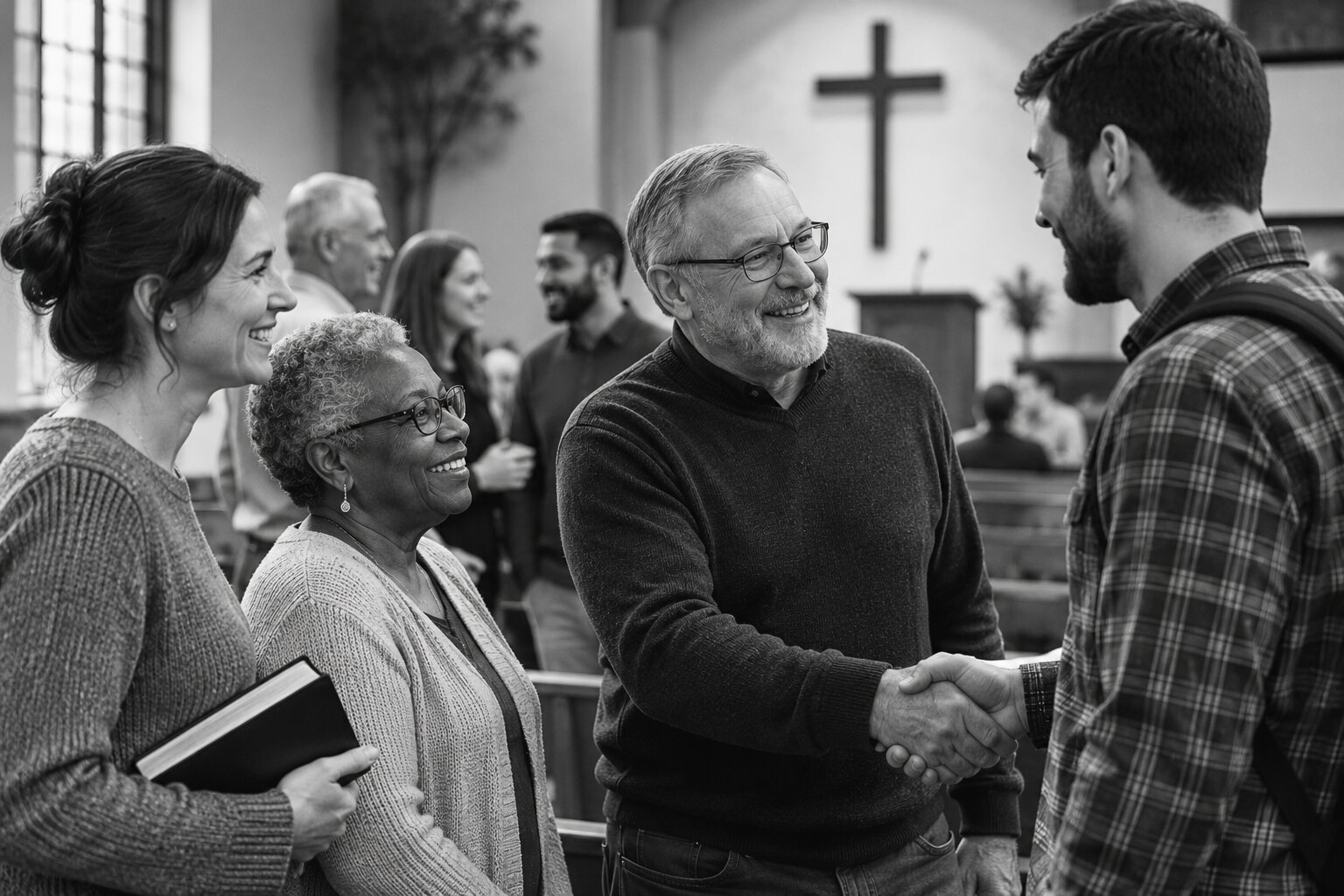
Have you ever wondered why God brings so many different kinds of people together in the church? Think about it. We come from different backgrounds, have different personalities, possess different abilities, and sometimes hold very different opinions about things that have nothing to do with our salvation.
Some people are outgoing and seem to make friends wherever they go. Others are quiet and would rather sit in the back of the room without drawing attention to themselves. Some have spent decades studying Scripture, while others are still learning how to find the different books of the Bible.
And somehow, God brings all these people together and calls them one body.
Now, I think we sometimes overlook how extraordinary that really is.
In most areas of life, we naturally gravitate toward people who share our interests. We develop friendships with coworkers, neighbors, and people who enjoy the same activities we do. There is nothing necessarily wrong with that. But the church is supposed to be different.
Our unity is not primarily based upon shared hobbies, similar personalities, educational backgrounds, or even the fact that we happen to enjoy spending time together.
Our unity is found in Jesus Christ.
And that raises an important question. If Christ has brought us together as members of His body, what exactly are we supposed to do with one another?
Is the Christian life simply about attending worship services, listening to sermons, and occasionally participating in church activities? Or has God called us into something much deeper?
I believe Scripture gives us a clear answer.
The Christian life was never intended to be lived entirely on our own. God has designed His church so that believers grow together through His Word, the work of the Holy Spirit, and the relationships He establishes among His people.
That means we need more than a place to attend on Sunday.
We need one another.
And perhaps one of the greatest challenges for Christians today is learning what it actually means to belong to a body rather than simply being part of an audience.
We Are Members of One Body, Not Independent Christians
The apostle Paul uses an illustration in 1 Corinthians 12 that I believe every Christian should spend time considering.
He compares the church to the human body.
A body consists of many different members. We have hands, feet, eyes, ears, and countless other parts, each performing a function necessary for the body to operate properly.
But none of those parts exists independently of the rest.
Imagine your hand suddenly deciding that it no longer needs your arm. Perhaps it believes it can function perfectly well without being connected to anything else.
That would be ridiculous, wouldn’t it?
A hand separated from the body cannot fulfill the purpose for which it was created.
Yet sometimes Christians approach the church with a similar attitude.
We say that we love Jesus, believe the Bible, and have a personal relationship with God. We study Scripture privately, listen to sermons online, and pray when we have time.
Then we conclude that meaningful involvement with other believers is unnecessary.
But Paul presents a very different understanding.
In 1 Corinthians 12:12–27, he explains that believers are members of one body through the work of the Holy Spirit. Although the members have different functions, they belong to one another because they belong to Christ.
This means that Christian unity is not something we create by finding people who happen to agree with us.
It is a reality established through our union with Jesus Christ.
And because that unity is real, we are called to live in ways that reflect it.
Now, this does not mean every believer must possess the same personality, interests, or abilities. In fact, the diversity of the body is part of God’s design.
The problem begins when we assume that our differences make certain members more valuable than others.
Perhaps someone is an excellent Bible teacher, and the congregation recognizes the importance of that person’s ministry. Another member quietly arrives early each Sunday to prepare the building, repair broken equipment, or make sure everything is ready for worship.
Which person is more important?
We might instinctively choose the teacher because the ministry is more visible.
But would the congregation function properly if everyone wanted to teach and nobody was willing to carry out the countless other responsibilities necessary for its life together?
Paul makes this point when he explains that the members of the body who appear weaker are indispensable.
Think about that word: indispensable.
Not merely useful when convenient.
Necessary.
That should challenge the way we evaluate our contributions to the church.
Some of us may never stand behind a pulpit or lead a large ministry. We may not possess extraordinary speaking abilities or have the opportunity to serve in a highly visible position.
But that does not mean God has given us nothing worthwhile to contribute.
Every believer belongs to the body of Christ.
And every believer should take seriously the responsibility of contributing to its growth.
Growing Spiritually Requires More Than Receiving Information
Let me give you an example.
Imagine a young man who begins attending a church because he enjoys the pastor’s teaching. He has recently developed an interest in theology, and he appreciates the careful explanation of Scripture.
For the next several years, he attends faithfully, takes notes during sermons, and reads theological books throughout the week.
His knowledge grows considerably.
He can explain justification, sanctification, the doctrines of grace, and the relationship between the Old and New Testaments.
But there is something missing.
He rarely speaks with anyone outside the worship service. He does not participate in the life of the congregation, and he has little interest in getting to know other believers.
When disagreements arise, he becomes impatient. When someone asks a basic theological question, he assumes they have not studied enough. And when the church needs volunteers, he believes his time would be better spent reading another book.
Now, let me ask you something.
Is this man growing in Christian maturity?
In one sense, his biblical knowledge may have increased. And that is certainly valuable.
But spiritual maturity involves more than collecting correct information.
In Ephesians 4:11–16, Paul explains that Christ gives ministers to equip the saints for the work of ministry, so that the body of Christ may be built up.
He describes believers growing toward maturity, becoming stable in sound doctrine, and speaking the truth in love.
Notice how those ideas belong together.
We need sound teaching so that we are not carried away by false doctrine. But we also need love, service, humility, and genuine participation in the life of the body.
The goal is not simply to produce Christians who know more than they did five years ago.
It is to see believers increasingly conformed to the likeness of Jesus Christ.
And much of that growth happens through relationships.
Consider the young man in our example.
He may understand the biblical definition of patience, but how will he learn to practice patience if he avoids everyone who frustrates him?
He may know that Christians are supposed to bear one another’s burdens, but how will he learn what that means if he never develops relationships deep enough to discover what other people are carrying?
And he may be able to explain humility, but what happens when an older Christian gently points out that his knowledge has begun making him arrogant?
Will he listen?
Or will he become defensive because he assumes he already knows better?
I think this illustrates something important.
God has not given the church merely as a place where Christians receive religious instruction.
He has also given us a community in which that instruction is supposed to become visible through the way we live.
We need the preaching and teaching of God’s Word.
But we also need opportunities to practice what we are learning.
And other believers are often part of how God exposes the areas in which we still need to grow.
Learning to Serve With the Gifts God Has Given Us
One of the beautiful things about the church is that God has not given every Christian the same abilities.
Think about what would happen if everyone in a congregation possessed exactly the same gifts.
Suppose everyone wanted to lead a Bible study, but nobody was interested in organizing practical assistance for families in need.
Or imagine a church filled with people who were excellent at planning activities, but nobody wanted to spend time listening to someone who was lonely or discouraged.
The congregation might become very active in certain areas while neglecting important responsibilities in others.
That is why the diversity of gifts matters.
Romans 12:4–8 reminds believers that although we have many members in one body, those members do not all possess the same function. Paul then discusses different gifts and the responsibility to exercise them faithfully.
Likewise, 1 Peter 4:10 instructs believers to use whatever gift they have received to serve one another as good stewards of God’s varied grace.
Notice that Peter does not describe our gifts as personal achievements intended to make us feel important.
They are gifts of grace.
And they are given for service.
That changes how we should think about our abilities.
Perhaps you are someone who enjoys organizing things. You are good at creating schedules, coordinating activities, and making sure important details are not overlooked.
You may not consider those abilities particularly spiritual.
But what if your congregation has a ministry that regularly struggles because nobody has the time or ability to organize it effectively?
Could God use your abilities to serve His people?
Of course He could.
Or perhaps you are someone who has a natural ability to listen.
People feel comfortable talking with you because you do not immediately interrupt them or turn every conversation toward yourself.
What if you began intentionally spending time with members of your congregation who have very few people willing to listen to them?
Imagine an elderly church member whose spouse died several years ago.
They still attend worship regularly, but much of their week is spent alone.
You might not be able to change their circumstances. You cannot replace the person they have lost.
But perhaps you could invite them to lunch, ask about their life, and listen to the stories they rarely have an opportunity to share.
Would that be meaningful Christian service?
I believe it would.
And consider a young couple who recently joined a congregation. They have two small children and are trying to adjust to a new community.
Perhaps one of the parents wants to participate in a Bible study but finds it difficult because of childcare responsibilities.
Another church member offers to help supervise the children during the gathering.
That may not sound like an extraordinary ministry.
But what if that simple act of service makes it possible for the parents to develop meaningful relationships and grow through biblical instruction?
Do you see how one person’s willingness to serve can contribute to another person’s spiritual growth?
This is what happens when we begin understanding the church as a body rather than a collection of independent individuals.
Our gifts are not meant to bring attention to ourselves.
They are meant to help build up the people Christ has redeemed.
And sometimes the most valuable service we provide will be something that nobody outside the congregation ever notices.
We Need to Learn From Christians Who Are Different From Us
There is another aspect of church life that I think we need to appreciate more.
God often uses people who are very different from us to help us grow.
Consider the relationships between younger and older believers.
A young Christian may possess considerable energy, enthusiasm, and a willingness to explore new ways of doing things. An older believer may have decades of experience walking with Christ through marriage, parenting, disappointment, loss, and changing circumstances.
Both have something valuable to contribute.
But what happens if the younger Christian assumes that older believers have nothing relevant to teach because they do not understand modern culture?
Or if the older Christian dismisses every idea from a younger person simply because it differs from the way things have always been done?
The entire congregation loses opportunities for growth.
Titus 2 presents a picture of older and younger believers being instructed in godly conduct, with older Christians helping teach and encourage those who are younger.
The passage contains particular instructions for different groups, but it also reveals an important principle: Christian maturity is strengthened as believers learn from one another.
Imagine a young father who is struggling to balance work and family responsibilities.
He loves his wife and children, but he has become so focused on his career that he rarely spends meaningful time with them.
An older man in the congregation notices that the younger father seems exhausted and invites him to have coffee.
During the conversation, the older man shares something from his own experience.
When his children were young, he spent years working overtime because he believed providing financial security was the most important way to care for them.
He eventually realized that his family also needed his presence, patience, and attention.
Now, the older man is not claiming that every Christian should work identical hours or make the same professional decisions.
He is sharing wisdom gained through his own failures and experiences.
And perhaps the younger father begins recognizing a problem in his own priorities.
That is something a theological textbook may not accomplish in quite the same way.
The book can teach biblical principles.
But a mature believer can sometimes help us understand how those principles apply in complicated circumstances.
Of course, age alone does not guarantee wisdom. An older Christian can still be immature, and a younger believer may possess considerable biblical understanding.
But Scripture encourages us to recognize the value of faithful relationships across different stages of life.
We should be willing to learn from people who have walked with Christ longer than we have.
And those who have greater experience should remember that their responsibility is not simply to criticize younger generations.
It is to help them grow.
That requires patience on both sides.
And perhaps that is one reason God brings people of different ages and backgrounds into the same congregation.
We have things to teach one another.
And we also have things to learn.
Growing Together Means Learning to Handle Disagreements
Let me address something that every church will eventually experience.
Disagreement.
No congregation is made up of people who think exactly alike.
We may agree about the authority of Scripture, the gospel of Jesus Christ, and the importance of faithful worship. But that does not mean we will agree about every practical decision.
Perhaps the church needs to decide whether to change the time of its midweek gathering.
Some members prefer an earlier meeting because they have young children. Others believe a later meeting would make it easier for people who work during the day.
Both groups have legitimate concerns.
But before long, a simple scheduling question begins creating tension.
Some people feel that their needs are being ignored. Others become frustrated because they think the congregation is resisting necessary change.
Eventually, people begin discussing the disagreement with everyone except the people directly involved.
Now, think about what is happening.
The original issue was not necessarily a matter of sin or false doctrine.
It was a practical decision requiring wisdom, communication, and consideration for others.
Yet the way the disagreement is being handled may reveal pride, impatience, and selfishness.
And that is where Christian maturity becomes especially important.
In Philippians 2:3–4, Paul instructs believers to reject selfish ambition and conceit, to count others more significant than themselves, and to consider the interests of others rather than only their own.
That does not mean every member must abandon their opinions.
It means we should approach disagreements with humility.
Perhaps someone has a concern we have not fully considered.
Perhaps the decision that seems most convenient for our family would create genuine difficulties for another group of members.
And perhaps our desire to win the argument has become more important than the issue itself.
These are things we need to examine.
A spiritually mature church is not one where disagreement never occurs.
It is one where believers increasingly learn to address disagreements according to biblical principles.
That means speaking truthfully, listening carefully, refusing to spread unnecessary gossip, and being willing to acknowledge our own mistakes.
It also means recognizing that not every disagreement carries the same theological importance.
There are matters in which Scripture has spoken clearly and the church must remain faithful regardless of popular opinion.
But there are also practical decisions where Christians may legitimately reach different conclusions.
We should not treat every scheduling disagreement or ministry preference as though the gospel itself were at stake.
And we should not allow personal frustrations to destroy relationships Christ has established.
Colossians 3:13 calls believers to bear with one another and forgive one another, just as the Lord has forgiven them.
That is not always easy.
Sometimes we must choose to extend patience toward someone who has irritated us repeatedly.
Other times we must be humble enough to apologize because we have been the difficult person.
But these ordinary challenges are part of learning to love one another.
And love is not an optional characteristic of a mature church.
It is essential.
The Whole Body Suffers When Members Withdraw
There is something else I want us to consider, particularly because it is easy to underestimate how our individual choices affect other believers.
What happens when someone gradually withdraws from the life of the church?
I’m not speaking about people who are unable to attend because of illness, disability, caregiving responsibilities, or other legitimate circumstances. Those situations require understanding and appropriate pastoral care.
I am talking about someone who begins treating the congregation as though it has little connection to the rest of their life.
Perhaps they still attend worship occasionally.
But they no longer develop relationships, participate in fellowship, or make any effort to become involved with other believers.
Eventually, they begin feeling disconnected.
And because they feel disconnected, they become even less interested in participating.
It can become a difficult cycle.
Now, we should be careful not to assume that every person who withdraws is simply being selfish or spiritually careless. Some have experienced painful conflicts, discouragement, or unhealthy church environments that need to be addressed seriously.
But in an otherwise faithful congregation, continued isolation can deprive both the individual and the church of important blessings.
Consider what happens when a member who has quietly encouraged people for years stops participating.
Perhaps nobody immediately notices how much that person contributed.
But gradually, some of the younger believers who depended upon their encouragement begin missing those conversations.
A struggling member no longer receives the occasional phone call that once helped them feel remembered.
And opportunities for service remain unfilled.
The absence affects more than one person.
Paul teaches in 1 Corinthians 12:26 that when one member suffers, all suffer together, and when one member is honored, all rejoice together.
That principle reminds us that the spiritual well-being of believers is not entirely disconnected from the health of the congregation.
We are members of one body.
When someone is struggling, we should care.
When someone is drifting, we should seek to encourage them.
And when someone has become discouraged or feels forgotten, we should not assume that another person will eventually do something about it.
Perhaps God has placed us in a position to help.
Sometimes that help may be as simple as making a phone call.
Other times it may involve listening patiently, inviting someone into fellowship, or encouraging them to speak with a pastor or elder.
And if someone has been harmed by serious misconduct within a church, meaningful care may require protection, accountability, and assistance in finding a safe and faithful congregation.
Christian fellowship should never become an excuse for minimizing wrongdoing or pressuring people to remain in harmful situations.
But within a healthy church, the responsibility to care for one another belongs to the whole body.
And that care becomes possible only when we begin treating other believers as people whose lives genuinely matter to us.
Christ Is the One Who Makes the Body Grow
Now, there is an important truth we need to remember before we turn Christian fellowship into another collection of responsibilities that we must accomplish through our own strength.
The growth of the church ultimately comes from Jesus Christ.
We can organize programs, teach classes, encourage members, and develop opportunities for service.
Those things may be valuable.
But no amount of organizational skill can produce genuine spiritual life.
Only God can do that.
In Ephesians 4:15–16, Paul explains that the body grows from Christ, who is its head, as each part works properly and the body builds itself up in love.
Notice the relationship.
Christ is the source of the body’s life and growth.
Yet the members are genuinely involved in the process.
That should remind us of two important truths.
First, our service matters.
God has graciously chosen to use the gifts, abilities, and responsibilities of His people as part of His work in building up the church.
A faithful teacher contributes through biblical instruction.
A mature Christian contributes through encouragement and discipleship.
A member who demonstrates hospitality, generosity, or practical assistance may help create opportunities for others to grow.
And even those whose physical limitations prevent them from participating in more active ministries can contribute through prayer, encouragement, and faithful witness according to their circumstances.
Second, none of us should imagine that the church depends ultimately upon our personal abilities.
We are servants, not saviors.
Christ is the head of His body.
And we should be grateful that the growth of His church does not rest entirely upon our strength, intelligence, or organizational ability.
This also helps us understand why the ordinary means of grace remain central to Christian maturity.
The faithful preaching of Scripture, prayer, the sacraments, and the fellowship of believers are not merely religious traditions we maintain because previous generations practiced them.
They are among the means God has appointed to nourish and strengthen His people.
The church is not a social organization that happens to include some biblical teaching.
It is the assembly of people whom Christ has redeemed and called to worship Him.
And the Holy Spirit works through God’s Word to bring believers into a growing knowledge of their Savior.
But spiritual growth is not measured simply by how busy the church becomes.
A congregation can offer programs every night of the week and still fail to cultivate meaningful Christian maturity.
Likewise, a smaller congregation with fewer organized activities may be faithfully growing through biblical preaching, genuine relationships, prayer, and humble service.
The question is not whether we have created enough things for people to do.
The question is whether we are helping one another grow in the grace and knowledge of Jesus Christ.
And that requires us to keep Christ at the center of everything.
Growing Together for the Glory of Christ
Let me return to where we began.
Why does God bring so many different people together in the church?
Why not simply allow each Christian to study Scripture privately, worship independently, and avoid all the difficulties that come with human relationships?
Because God’s purpose for His people includes something greater than individual spiritual development.
He is building a body.
And that body is meant to reflect the unity, love, holiness, and grace of the Savior to whom it belongs.
Think about what that means for an ordinary Sunday.
Perhaps you arrive at church after a difficult week. You are tired, distracted, and honestly looking forward to going home and resting.
You listen to the sermon, participate in worship, and begin preparing to leave.
Then you notice someone standing alone near the entrance.
You have seen this person several times, but you have never really spoken with them.
What should you do?
You could simply go home.
There may be nothing obviously sinful about that decision.
But perhaps you have an opportunity to do something meaningful.
You could introduce yourself, ask how they are doing, and begin a conversation.
You may discover that they are new to the community and have been struggling to develop friendships.
Or perhaps they have attended the congregation for years but recently experienced a loss that has left them feeling isolated.
You do not need to deliver a theological lecture or solve every problem they are facing.
Perhaps you simply need to listen.
And maybe that conversation becomes the beginning of a meaningful Christian friendship.
Now, imagine what might happen if more of us began approaching church life that way.
Instead of thinking only about whether the service met our expectations, we might begin considering how we can encourage someone else.
Instead of assuming that ministry belongs primarily to the pastor and a handful of volunteers, we might begin recognizing the gifts God has entrusted to us.
Instead of becoming frustrated whenever another believer has a different personality or opinion, we might ask whether God is using that relationship to teach us greater patience and humility.
And rather than measuring our spiritual maturity solely by how much biblical knowledge we possess, we might begin examining whether the truths we profess are changing the way we love and serve others.
Of course, none of us will do this perfectly.
There will be times when we become selfish, impatient, or overly concerned with our own preferences.
There will be occasions when we neglect opportunities to serve or fail to respond with the grace we should have demonstrated.
When those things happen, we need repentance.
We need forgiveness.
And we need to remember that our acceptance before God does not depend upon the perfection of our service to the church.
It rests upon the finished work of Jesus Christ.
He is the Savior who loved His people and gave Himself for them.
He is the One who has united believers to Himself through faith.
And through the ongoing work of the Holy Spirit, He continues making His people holy.
That is why the church should never become a place where we compete to prove who is the most knowledgeable, talented, or spiritually impressive.
We are all recipients of God’s undeserved grace.
Some of us have been Christians for many years. Others are just beginning to understand the gospel. Some have been entrusted with visible responsibilities, while others serve quietly in ways that few people notice.
But none of us has any reason to boast in ourselves.
Everything we possess is ultimately a gift from God.
And those gifts are meant to be used for His glory and the good of His people.
So perhaps the next time we gather with our local congregation, we should remember that we are not simply attending another religious event.
We are gathering with people whom Jesus Christ has redeemed.
People who are still struggling with sin.
People who need encouragement, instruction, correction, and grace.
People who have gifts and experiences that may strengthen our own faith.
And people whom God has called us to love.
We need them.
And they need us.
Not because the body of Christ is ultimately dependent upon any one of us, but because God has graciously designed His church so that its members grow together under the lordship of Jesus Christ.
Christian maturity is not simply about how much we grow as individuals. It is also about learning to love, encourage, serve, and build up one another as members of the body of Christ, recognizing that our Savior is the One who gives us life and causes His church to grow for His glory.
And perhaps that is one of the most beautiful things about the local church.
God takes sinners who would otherwise have very little reason to belong together, unites them through His Son, and teaches them to become a people who increasingly reflect the grace they have received.