

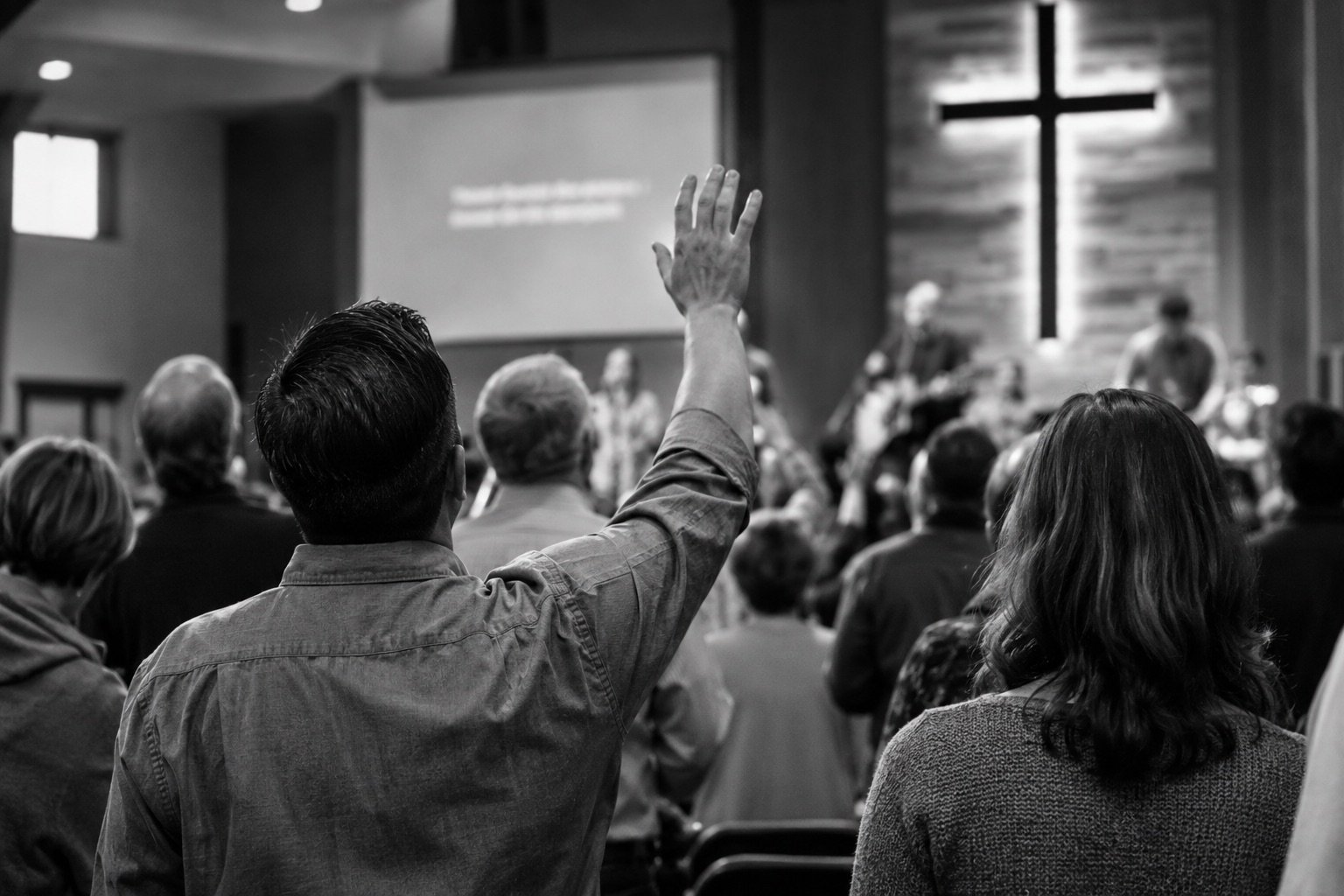
Let me ask you something. Why do you go to church? Is it because you enjoy the music? Perhaps you like the pastor’s preaching, the friendships you have developed, or the feeling of belonging to a community. Maybe you attend because that is what your parents taught you to do, and going to church has simply become part of your weekly routine.
There is nothing necessarily wrong with those reasons. Good preaching is important. Fellowship with other believers is a blessing. And there is certainly something wonderful about gathering with people who share our faith. But I wonder how often we stop to consider why the church actually exists in the first place.
What if the music is not particularly good? What if the pastor is not the most entertaining speaker? What if the congregation is small, the building is old, and there are no impressive programs for your family? Would that church still have something valuable to offer?
And perhaps a more difficult question: If you could listen to excellent sermons online, study theology on your own, and worship God in the privacy of your home, would you still need to belong to a local church?
I think these are important questions because somewhere along the way, many Christians have begun treating the church as though it were simply another service available to consumers. We look for a congregation that meets our expectations, accommodates our preferences, and provides programs that fit our interests. And when something disappoints us, we begin looking somewhere else.
Now, there are legitimate reasons to leave a church, particularly when its leadership abandons biblical teaching, tolerates serious wrongdoing, or refuses to address harmful conduct. But I am not talking about those situations. I am talking about our tendency to approach worship and church membership primarily by asking what we will receive rather than asking what God has called us to do.
Have we forgotten that the church does not belong to us?
The church belongs to Jesus Christ.
And understanding that truth changes how we approach worship, fellowship, church leadership, and our responsibilities toward one another.
The Church Is More Than a Place We Attend
When we hear the word church, most of us immediately picture a building. Perhaps we imagine a traditional sanctuary with wooden pews and stained-glass windows, or a modern auditorium with comfortable seating and a large worship stage.
But the church is not ultimately defined by its architecture.
In the New Testament, the church is the people whom God has called to Himself through Jesus Christ. Believers are united to Christ by faith and brought into fellowship with one another. The church is described as Christ’s body, God’s household, and a people set apart for His glory.
That distinction matters because Christianity is not simply an individual relationship with God that happens to include occasional gatherings with other believers.
When God saves us, He does not call us into spiritual isolation. He joins us to Christ and, through Him, to His people.
Paul explains this in 1 Corinthians 12, where he compares the church to a human body. A body contains many different members, each with a particular function, yet all belong to the same body. The eye cannot dismiss the hand as unnecessary, and the head cannot declare that it has no need of the feet.
Think about what Paul is saying.
God has designed the Christian life so that believers depend upon one another. We are not all given the same abilities, experiences, or responsibilities. Some are gifted teachers. Others are especially effective at encouraging people, extending hospitality, organizing practical assistance, or quietly caring for those who are struggling.
But every member matters.
Imagine a small church with about seventy people. The pastor faithfully preaches Scripture each Sunday. A retired couple welcomes visitors and helps them feel comfortable. A younger man regularly gives an elderly member a ride to worship because she can no longer drive. Several families prepare meals when someone becomes seriously ill.
None of these activities may appear especially impressive. There are no large crowds, television cameras, or popular social media accounts drawing attention to what is happening.
Yet this congregation may be demonstrating something far more important than outward success.
It is functioning as a body.
And that is something we should not overlook.
Of course, the church exists throughout the world, extending far beyond any single congregation or denomination. All who truly belong to Christ are part of His universal church. But Scripture also shows Christians gathering in identifiable local congregations under the ministry and care of recognized leaders.
The believers in Jerusalem devoted themselves to the apostles’ teaching, fellowship, the breaking of bread, and prayer, as described in Acts 2:42. Throughout the New Testament, we find congregations meeting together, receiving instruction, appointing elders, caring for members, and addressing problems within their communities.
The local church was not an optional addition to Christian life. It was the ordinary setting in which believers worshiped, learned, grew, and served together.
That should challenge our modern tendency to think of Christianity primarily in individual terms.
We certainly must each personally repent and believe in Jesus Christ. Nobody is saved simply because they attend church or belong to a Christian family. But genuine faith does not leave us indifferent toward the people Christ has redeemed.
If we belong to Him, then His people matter to us.
Worship Is About God, Not Our Preferences
I remember how easy it can be for people to judge a church service based upon how it makes them feel. We might leave saying that the music was wonderful, the sermon was inspiring, or the atmosphere was especially moving.
But what exactly makes worship acceptable to God?
Is it the emotional intensity of the congregation? The quality of the musicians? The pastor’s ability to hold everyone’s attention? Or is there something more fundamental?
In John 4:23–24, Jesus teaches that true worshipers worship the Father in spirit and truth. Worship cannot be reduced to outward performance or emotional experience. It must be directed toward the true God according to the revelation He has given.
This is especially important because we are naturally inclined to approach worship from our own perspective.
We ask whether we enjoyed the sermon. We ask whether the songs matched our preferences. We ask whether the service made us feel spiritually refreshed.
Again, those concerns are not necessarily wrong. A sermon should be understandable and edifying. Congregational singing should help believers express biblical truth. Worship should never be treated carelessly.
But our personal enjoyment is not the final measure of faithful worship.
The more important question is whether God is being honored according to His Word.
Historic Reformed theology has emphasized this principle for centuries. God has not left His people free to invent whatever forms of worship seem most appealing. Rather, He instructs His church through Scripture, directing our attention to the preaching and hearing of His Word, prayer, singing, and the proper administration of baptism and the Lord’s Supper.
This does not mean every faithful church must have identical architecture, musical arrangements, or service schedules. Christians may differ over certain practical expressions of worship. But the substance of worship must be governed by God’s revelation rather than by our desire to entertain or impress.
Consider what happens when a congregation begins measuring success primarily by attendance numbers or emotional excitement.
There may be growing pressure to make worship more entertaining, shorten difficult biblical teaching, avoid controversial doctrines, or imitate whatever methods seem most successful elsewhere.
And before long, the question may no longer be, “What has God commanded His church to do?” Instead, it becomes, “What will attract the largest crowd?”
Those are not necessarily the same question.
A faithful church should certainly desire to welcome visitors and make the gospel understandable. But attracting people must never become more important than proclaiming Christ faithfully.
Think about a pastor who is preaching through a difficult passage of Scripture. The passage addresses sin, repentance, judgment, or some other doctrine that makes people uncomfortable.
He has a choice.
He can explain the passage faithfully, even though some listeners may not appreciate what they hear. Or he can avoid the difficult portions and offer a message that everyone finds encouraging.
Which approach demonstrates greater love for the congregation?
I would argue that genuine pastoral love requires faithfulness to God’s Word, even when the truth is uncomfortable. A doctor who refuses to tell a patient about a serious illness because the news might be upsetting is not demonstrating compassion. In the same way, a pastor who consistently avoids biblical truth to preserve the congregation’s comfort is not faithfully caring for their souls.
But this responsibility does not belong only to the pastor.
We also need to examine our own expectations.
Do we attend worship because we want to hear from God through His Word, or because we want a religious experience that makes us feel good about ourselves?
There is a significant difference between the two.
Why Preaching and the Sacraments Matter
One of the blessings of living in our generation is the extraordinary access we have to Christian teaching. We can listen to sermons from pastors around the world, study theological lectures, download commentaries, and examine biblical passages using resources that previous generations could scarcely have imagined.
I believe these resources can be tremendously beneficial.
But they also create an interesting temptation.
Why sit under the preaching of a local pastor when you can listen to a more gifted speaker online? Why attend a small church when a large ministry offers professionally produced services, excellent music, and teaching available whenever you want?
The answer involves understanding what God has actually given His church.
Preaching is not merely the transfer of religious information from one person to another. It is one of the ordinary means through which God ministers to His people. Through the faithful proclamation of Scripture, Christ is announced, sinners are called to repentance and faith, and believers are instructed, corrected, and strengthened.
Second Timothy 4:2 charges ministers to preach the Word, including the responsibility to reprove, rebuke, and exhort with patience and teaching.
That kind of ministry requires more than delivering an impressive presentation.
A local pastor has opportunities to know the congregation he serves. He may understand that a particular family is grieving, that a young believer is struggling with doubt, or that someone needs correction because of a pattern of destructive behavior.
He is not merely delivering religious content to an audience. He has been entrusted with the spiritual care of real people.
The same is true of the sacraments.
In the Reformed tradition, baptism and the Lord’s Supper are understood as means of grace instituted by Jesus Christ. They are visible signs and seals of God’s covenant promises, pointing us to Christ and His saving work.
Baptism directs our attention to cleansing from sin, union with Christ, and belonging to His covenant people. It is not a magical ceremony that automatically produces salvation, nor does the outward washing replace the necessity of the Holy Spirit’s regenerating work.
Likewise, the Lord’s Supper is more than a casual religious reminder.
When believers receive the bread and cup in faith, they remember Christ’s sacrificial death, proclaim His saving work, and are spiritually nourished through communion with Him by the Holy Spirit. Christ is not physically reproduced or sacrificed again. His once-for-all sacrifice is entirely sufficient.
Paul’s instructions in 1 Corinthians 11 show that the Lord’s Supper must be approached seriously, with discernment and concern for the unity of the congregation.
These practices remind us that Christianity is not merely about collecting biblical knowledge.
God has appointed ways in which His people are to receive His promises, remember His grace, and grow together in faith.
A recorded sermon may be helpful, but it cannot replace all the responsibilities and blessings of belonging to an actual congregation. Watching other Christians celebrate the Lord’s Supper is not the same as participating in it with the church. Listening to a pastor who has never met you cannot completely replace the care of elders who know you and have accepted responsibility for shepherding the congregation.
And I think that is something worth remembering in an age when nearly everything can be experienced through a screen.
Technology can assist the ministry of the church. It cannot fully replace the church itself.
The Church Is Also Where We Learn to Love Difficult People
Let me move to a subject that may be a little uncomfortable.
Churches are filled with sinners.
Now, that statement should not surprise anyone. The gospel itself teaches that we are sinners saved by grace. Yet we sometimes enter a congregation expecting everyone to behave as though they have already achieved perfect holiness.
And when someone disappoints us, we become frustrated.
Maybe another member says something insensitive. Perhaps a ministry leader forgets an important commitment. Someone may disagree with your opinion about how a particular activity should be organized. Or perhaps you discover that people in the church have habits and personalities that you simply do not enjoy.
What do you do?
It is easy to love the idea of Christian community. It is much harder to love actual Christians when they inconvenience us.
Consider a family who has recently joined a congregation. During their first several weeks, everyone seems welcoming. The sermons are encouraging, the people are friendly, and they begin to feel that they have finally found the perfect church.
Then they become involved in ministry.
They discover that volunteers disagree about how things should be done. Some people arrive late. Others fail to communicate clearly. A misunderstanding develops between two members, and suddenly the peaceful community they imagined begins to look much more complicated.
Does that mean they have chosen the wrong church?
Not necessarily.
It may simply mean that they are beginning to experience what genuine relationships involve.
The New Testament repeatedly commands Christians to bear with one another, forgive one another, encourage one another, and pursue peace. Those commands would hardly be necessary if everyone in the church were always easy to love.
Colossians 3:12–14 calls believers to compassion, kindness, humility, meekness, patience, forgiveness, and love. Notice how relational those qualities are.
We cannot meaningfully practice patience unless we encounter circumstances that test our patience. We cannot demonstrate forgiveness unless someone has wronged us. We cannot learn to bear with one another if we insist upon surrounding ourselves only with people who share our personalities and preferences.
This does not mean Christians should tolerate abuse, manipulation, predatory behavior, or unrepentant serious wrongdoing. Biblical forgiveness does not require pretending that harm never occurred, and restoring trust may require accountability, protection, and time. Churches have a responsibility to address serious sin rather than conceal it.
But ordinary disagreements and personal disappointments should not automatically become reasons to abandon fellowship.
Sometimes God uses the very relationships we find difficult to expose our pride and teach us humility.
Perhaps the person who annoys you is also someone God has called you to love.
That is not always easy to accept.
But Christian love was never intended to depend entirely upon personal compatibility.
Church Membership Means Sharing Responsibility
Another aspect of the local church that deserves attention is the responsibility believers have toward one another.
In our culture, membership often means receiving certain benefits. We join organizations because they offer access to services, facilities, or opportunities that interest us.
But belonging to a church should be understood differently.
Church membership is a public expression of commitment to a particular congregation, its biblical teaching, its spiritual oversight, and the mutual responsibilities shared by its members.
The New Testament assumes that Christians are known within congregations, that leaders have identifiable people under their care, and that believers are accountable to one another.
Hebrews 13:17 speaks of leaders keeping watch over souls as those who will give an account. First Peter 5:2–3 instructs elders to shepherd God’s flock willingly and by example, not through domination.
How can shepherds faithfully care for people if there is no meaningful relationship between them? And how can members fulfill their responsibilities toward one another if they treat church participation as something they can enter and leave without commitment?
I realize that formal church membership practices differ among Christian traditions. Scripture does not provide every detail of the administrative procedures churches use today. Nevertheless, the underlying principles of belonging, accountability, spiritual oversight, and mutual responsibility are clearly present.
Think about a member who has been attending the same congregation for several years. One Sunday, she suddenly stops coming. Weeks pass, and nobody contacts her.
Eventually, someone discovers that she has been dealing with a serious illness and has felt completely forgotten.
What does that say about the congregation?
Perhaps the church has excellent preaching and beautiful music. But if its members are not caring for one another, something important is missing.
Now imagine a different situation.
After noticing her absence, another member calls to check on her. An elder visits. Someone organizes meals, and a few people offer transportation to medical appointments.
These actions may appear small, but they demonstrate the practical meaning of Christian fellowship.
Galatians 6:2 instructs believers to bear one another’s burdens.
That is not merely a suggestion for particularly compassionate personalities. It is part of the responsibility we share as members of Christ’s body.
And we should not assume that this responsibility belongs only to the pastor, elders, or deacons.
Church leaders have particular duties, but the whole congregation is called to love and serve.
A young Christian may encourage an elderly believer. A retired person may disciple someone who is struggling to understand Scripture. A family may welcome a college student who has moved away from home. A member with practical skills may help repair something for someone who cannot afford to hire assistance.
The opportunities are nearly endless.
But they require us to stop thinking of the church as something we simply attend and begin understanding it as a people to whom we belong.
What About Churches That Have Hurt People?
There is one important issue I do not want to ignore.
Not everyone has pleasant memories of church.
Some people have experienced hypocrisy, manipulation, spiritual abuse, financial dishonesty, or serious misconduct by church leaders. Others have been deeply wounded by members who should have demonstrated compassion but instead responded with judgment or indifference.
We should never minimize those experiences.
It would be easy to tell someone who has been hurt that churches are filled with imperfect people and that they simply need to forgive and move on. But that response can be careless, especially when the harm involves serious wrongdoing or an abuse of authority.
Church leaders are not above correction.
They are accountable to God, and Scripture establishes qualifications for those who exercise spiritual oversight. First Timothy 3 and Titus 1 emphasize character, self-control, sound teaching, and faithfulness. These qualifications matter precisely because those entrusted with leadership can cause tremendous harm when they misuse their positions.
A faithful church should not protect its reputation at the expense of vulnerable people. Serious misconduct must be addressed honestly and appropriately, including reporting suspected crimes or abuse to the proper authorities.
At the same time, we should distinguish between the failures of sinful people and the institution Christ Himself established.
The fact that some churches have acted unfaithfully does not mean the church is unnecessary. It means churches must be continually brought under the authority of God’s Word.
If someone has experienced serious harm, returning to congregational life may require time, wise counsel, appropriate safeguards, and careful consideration of where genuine spiritual care can be found.
There is no virtue in remaining under abusive leadership simply to demonstrate loyalty.
But neither should we conclude that every congregation is equally untrustworthy.
Christ remains faithful even when those who claim to represent Him fail.
And for someone who has been wounded by a church, finding a healthy congregation where Scripture is taught faithfully, leadership is accountable, and members genuinely care for one another can be an important part of rebuilding trust.
What Should We Look for in a Faithful Church?
If the local church matters this much, then choosing where to worship and belong deserves serious consideration.
I would encourage Christians to begin with something more important than the size of the congregation, the quality of the music, or the number of programs available.
Begin with the gospel.
Does the church faithfully proclaim salvation by God’s grace through faith in Jesus Christ? Does it teach that our acceptance before God rests upon Christ’s righteousness and finished work rather than human merit? Does it uphold Scripture as the final authority for faith and life?
Those questions are foundational.
A church may offer wonderful activities and meaningful friendships, but if it distorts the gospel, it is failing in its most important responsibility.
We should also examine how Scripture is preached.
Does the pastor explain biblical passages in their context, helping people understand what God has actually revealed? Or does he regularly use isolated verses to support personal opinions, motivational speeches, or promises that Scripture itself does not make?
Faithful preaching should help us grow in our knowledge of God, recognize our sin, understand the gospel more deeply, and learn to live in obedience to Christ.
Beyond preaching, consider whether the church takes worship, prayer, baptism, and the Lord’s Supper seriously. Examine whether its leaders demonstrate biblical character and whether members are encouraged to care for one another.
And do not overlook how the church responds when problems arise.
No congregation is perfect. The important question is not whether problems ever occur, but whether the church seeks to address them truthfully, fairly, humbly, and according to Scripture.
We should also remember that the ideal church may not look particularly impressive from the outside.
A congregation of forty people meeting in a modest building may be faithfully proclaiming Christ and caring for its members. A much larger congregation may be doing the same. Size alone does not determine spiritual health.
Neither does having a famous pastor.
We need to learn to value faithfulness more than appearance.
And once we find a biblically faithful congregation, we should seriously consider what it means to become a committed part of its life rather than remaining perpetual visitors who never develop meaningful relationships.
Christ Is Building His Church
There is something deeply encouraging about the church when we understand it from a biblical perspective.
Jesus did not establish His church because He needed human beings to complete something He was incapable of accomplishing Himself.
He established it according to His gracious purpose.
In Matthew 16:18, Jesus declares that He will build His church. Notice whose work that ultimately is.
It is His church, and He is the One who builds it.
That should give us tremendous confidence, particularly when we become discouraged by the problems we see within Christianity.
Churches may struggle. Congregations may decline. Leaders may fail. Entire denominations may drift away from biblical truth. These realities should concern us, and we should never use Christ’s promises as an excuse for complacency.
But the future of Christ’s church does not ultimately rest upon our organizational ability, cultural influence, or financial resources.
It rests upon the faithfulness of Jesus Christ.
He has redeemed His people through His blood. He gathers them through the proclamation of the gospel. He nourishes them through the ministry of His Word and the sacraments. And by His Spirit, He continues to transform them into His likeness.
Ephesians 4:11–16 describes Christ giving ministers to equip the saints for the work of ministry so that the body may grow toward maturity. That is an extraordinary picture of what the church is intended to become.
Not a religious organization built around personalities.
Not an entertainment venue designed to attract consumers.
Not a social club where people gather primarily because they share similar interests.
But a redeemed people growing together in the knowledge, love, and likeness of Jesus Christ.
And that brings us back to where we began.
Why do we go to church?
We gather because God has called us to worship Him. We gather because we need to hear His Word proclaimed. We gather to receive the means of grace He has appointed, to encourage one another, to confess our common faith, and to participate in the life of the body to which Christ has joined us.
We gather not because everyone around us is perfect, but because we are sinners who need the grace of God and the fellowship of His people.
So perhaps the next time we prepare to attend church, we should ask ourselves a different question.
Instead of asking whether the service will meet all our expectations, perhaps we should ask how we can worship God faithfully and encourage the people He has placed around us.
Maybe there is someone who needs a kind word. Perhaps a visitor needs to feel welcomed. Maybe a family is going through a difficult season, and we have an opportunity to help. Or perhaps we are the ones who need encouragement, correction, or the reminder of God’s promises.
Whatever our circumstances, the local church is not something we should take lightly.
It is one of God’s gracious gifts to His people.
Of course, attendance alone cannot save us. Church membership cannot justify us before God. Baptism and the Lord’s Supper do not replace the necessity of faith in Christ. Our salvation rests entirely upon His finished work.
But the Savior who redeems us also calls us to live as part of His people.
And as we gather week after week, hearing His Word, receiving His grace, and learning to love one another, God continues His work of shaping us into a people who reflect the glory of His Son.
The church does not exist to make much of us. It exists to make much of Jesus Christ. And when we truly understand that, worship becomes more than a weekly activity, fellowship becomes more than friendship, and belonging to a local church becomes a joyful responsibility rooted in the grace of God.